


Sub-Total: £0.00
Are Pond Water-Clearing Products a Scam? An Aquatic Expert’s View
12 min read
Table of Contents
- Pond Water-Clearing Products: The Red Flags to Look For
- The Demonstration That Isn't What It Looks Like
- So What Is the Powder, Actually?
- Why "Every Pond Is Different" Isn't a Cop-Out
- What Legitimate Pond Treatments Actually Do (and How Long They Take)
- The Red Flags: A Quick Reference
- The Honest Answer: What Will Actually Clear Your Pond
- Pragmatic Summary
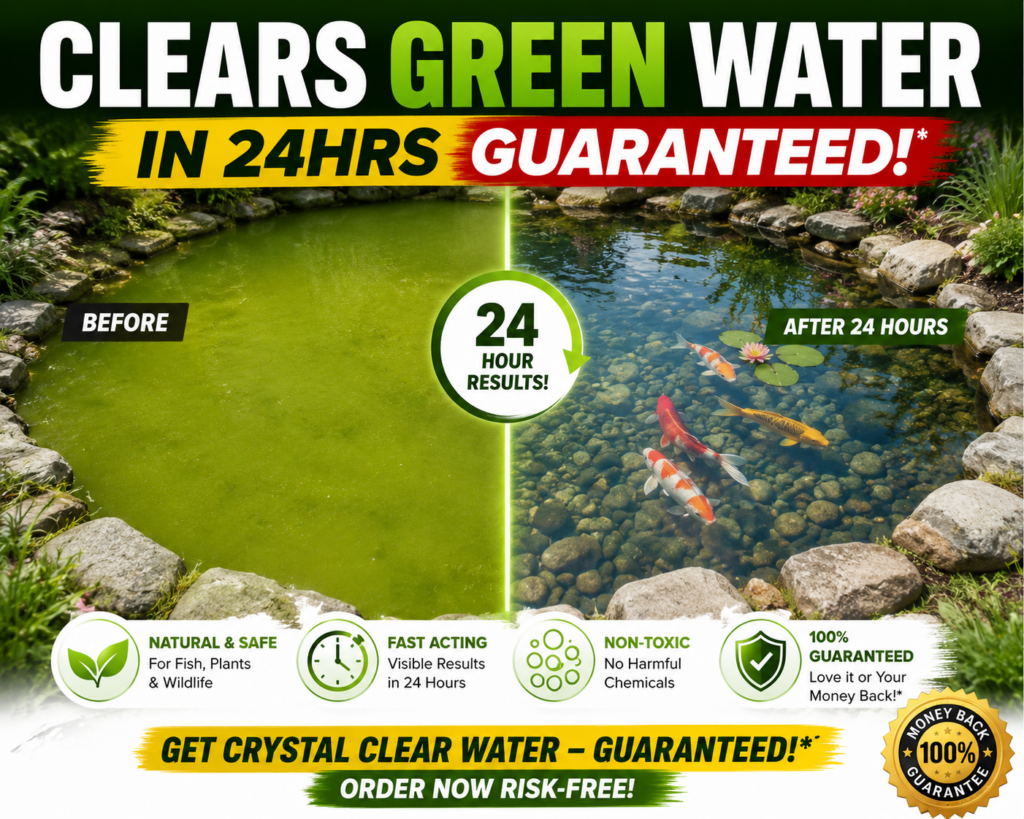
If you’ve been searching for reviews of pond water-clearing products and wondering whether they’re a scam, you’re not alone. Side-by-side images of a swamp-green pond and a crystal-clear one, a bold claim like “clears green ponds in 24 hours, guaranteed,” and enough five-star reviews to make you think: maybe this one is real.
I’ve been selling pond products for 35 years. I saw that exact advert, and I’ll be honest with you: I wanted it to be real. I genuinely thought it might be one of those rare products that comes along and changes the industry. So I did my research. What I found wasn’t encouraging.
Not every pond product is a scam. But a lot of what’s being pushed through social media advertising right now absolutely is. And even the legitimate ones come with claims that don’t survive contact with a real pond.
Here’s what to look for, and what to expect from pond water-clearing products that actually work.
Pond Water-Clearing Products: The Red Flags to Look For #
Those three changes should knock out four of the six red lights in one go. The keyphrase now appears in the introduction, the meta description, a subheading, and the closing line of the intro section, which also starts building your density count.
For outbound links, the simplest option is a reference to an authoritative source when you mention flocculants. Something like linking to a Royal Horticultural Society pond care page or a water treatment industry resource at the point where you explain what aluminium sulphate actually is. Want me to suggest some suitable anchor text for that?
I’ve got nothing against clever marketing. But when you start pulling at those threads, the whole thing unravels pretty quickly.
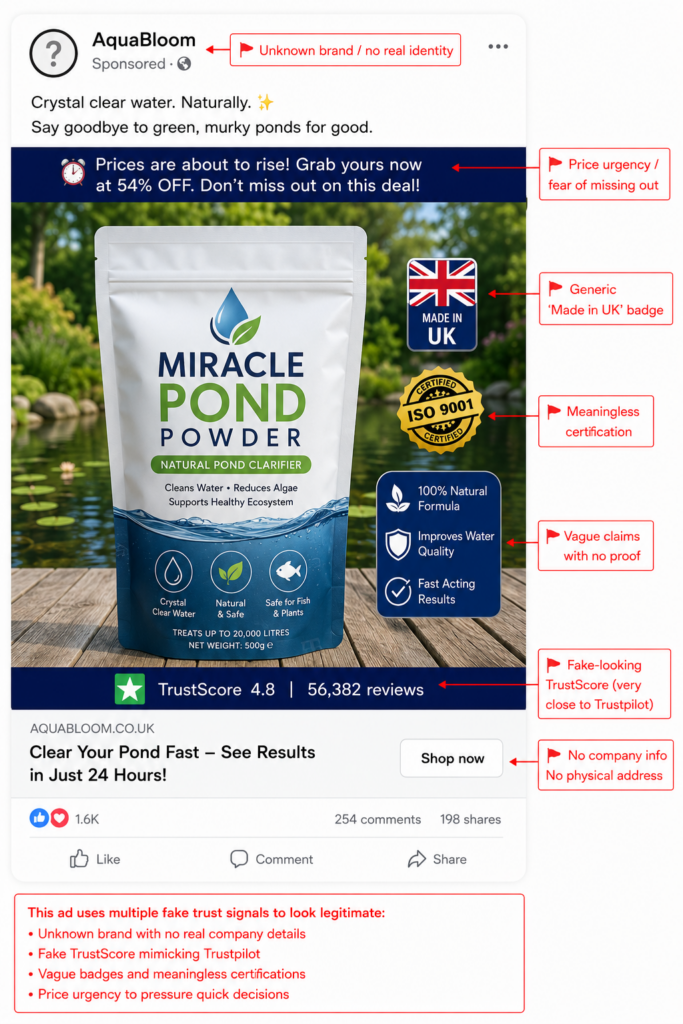
The reviews don’t add up. The number of comments changes throughout the day, negative feedback disappears, and when you look closely, many of the comments read like they were written by the same person, because they were. They’re AI-generated.
The credentials don’t exist. Citations from impressive-sounding institutions and researchers with PhDs are a classic trust signal. But if those people and places don’t exist when you search for them, that’s not a minor detail. That’s the whole game. One I looked at referenced a marine biology institute in California for a product designed for freshwater garden ponds. Freshwater and marine biology are about as related as your koi and a clownfish.
The country of origin keeps changing. Same product, same advert style, same claims. Made in the UK on one page. Made in Europe on another. Made in the US on a third. A genuine manufacturer knows where their product comes from.
No face. No name. No accountability. If I was standing behind a product, you’d see me. You’d know who I was, where to find me, and how to hold me to account. The absence of any real person attached to these adverts is telling.
The Demonstration That Isn’t What It Looks Like #
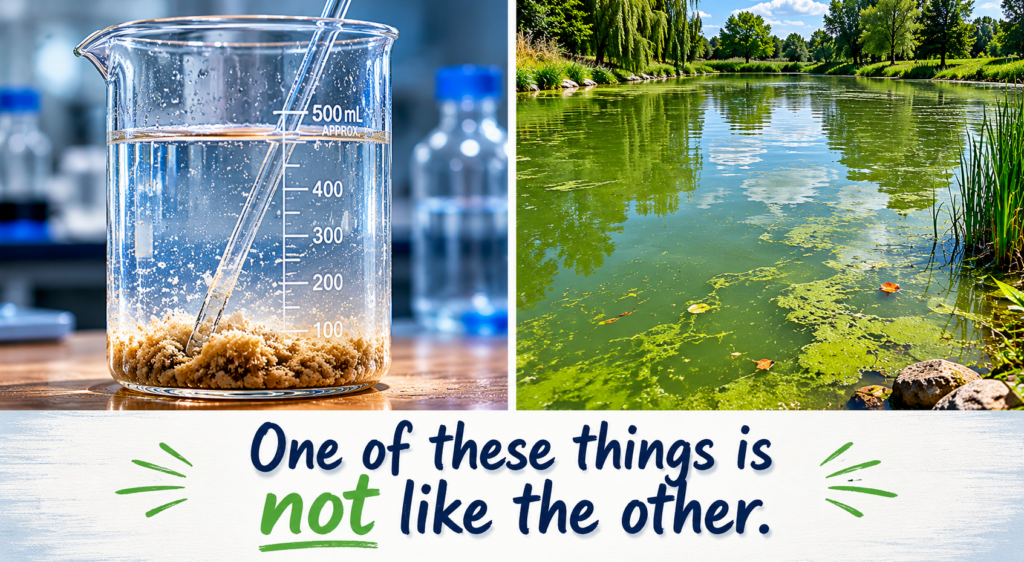
The jug video is a classic. Someone drops a powder into cloudy water, gives it a stir, and you watch the particles slowly settle out and the water goes clear.
Here’s the thing: that works. In a jug. In a controlled environment with no flow, no fish, no biological load, and no ongoing algae. A flocculant will drop suspended particles out of still water in a glass. That’s basic chemistry.
Your pond is not a jug.
I sold a product about 20 years ago called Bioclear Rapid. Our rep did exactly that demonstration, and I’ll be honest, it was impressive. He even drank the water afterwards to prove a point. I should probably have mentioned it was salt water before he did that. The look on his face was something I’ve never quite forgotten.
But we were always honest with customers about the caveat: to replicate that kind of circulation across an entire pond, you’d need to put a motorboat on it. The product worked, but it took weeks, sometimes months, not 24 hours.
Adding a liquid to a glass of water and watching it change colour takes about four seconds. That doesn’t mean the same principle scales to 5,000 litres of living pond water with fish, circulation, and biology doing their own thing.
So What Is the Powder, Actually? #
Here’s my best guess, and after 35 years I’m reasonably confident in it.
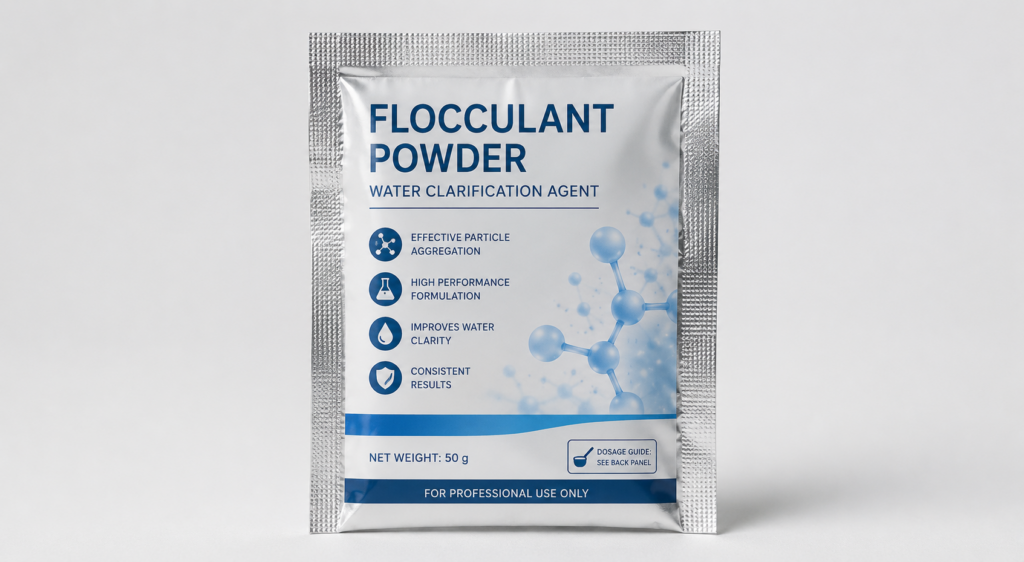
What you’re almost certainly receiving is a flocculant. Aluminium sulphate and polyaluminium chloride are the most common. They’ve been used in water treatment for decades, they’re cheap to produce, and they do exactly what that jug video shows: they cause suspended particles to clump together and drop out of the water column.
The product is real. The chemistry is real. The problem is the claims attached to it.
These compounds are available in bulk from industrial suppliers for pennies per gram. Repackaged into unbranded sachets, shipped from a fulfilment centre, and sold at a ten-times markup through a Facebook advert with 13,000 reviews that didn’t exist yesterday: that’s the business model. You’re not paying for the powder. You’re paying for the packaging, the algorithm, and someone’s very healthy margin.
And here’s the thing about flocculants in a pond context. In a jug of still water, yes, you’ll see results quickly. That’s not sleight of hand, that’s straightforward chemistry. But in a garden pond with circulation, biology, fish waste, ongoing algae growth, and thousands of litres of water, the conditions are completely different. You might see some short-term improvement in clarity. You will not solve your green water problem, because a flocculant doesn’t address the cause of it. It addresses the symptom, temporarily, and only in conditions nothing like your actual pond. There is every possibility it may not work at all. Floculants require correct pH and kH values to work. if your pond is outside of these it simply can’t work.
Suggesting there is one guaranteed solution no matter what the circumstances is a little crazy.
There’s also a subtler issue. Aluminium-based flocculants can affect water pH and may not be appropriate for ponds with fish, depending on dosage and water chemistry. I’m not saying it will kill your koi on contact. I’m saying that adding an unknown powder from an unverified source to a pond full of living things is not a decision to take lightly, and a company selling it this way is not going to give you a straight answer about what’s in it.
Why “Every Pond Is Different” Isn’t a Cop-Out #
I know it can feel like a brush-off when someone in a shop says “it depends on your pond.” But it genuinely does, and here’s why that matters.
Green water is caused by single-celled algae suspended in the water column. The reason your pond has green water could be any combination of the following:
- Too much direct sunlight with not enough plant coverage
- A filter that’s undersized, immature, or struggling with your fish load
- A UV clarifier with an ageing or failed bulb
- A fish population that has grown beyond what your filtration can handle
- High levels of nutrients in the water feeding the algae
- Poor circulation leaving fish waste to break down in the pond rather than being drawn into the filter
A product that claims to fix green water in 24 hours regardless of any of these factors is making a promise that the biology of a pond simply cannot keep. The treatment that works in a lightly stocked, well-filtered pond with a healthy UV will not produce the same result in a heavily stocked pond with an undersized filter and full sun.
This is why a conversation with someone who actually understands ponds is worth more than a miracle powder from a Facebook advert.
What Legitimate Pond Treatments Actually Do (and How Long They Take) #
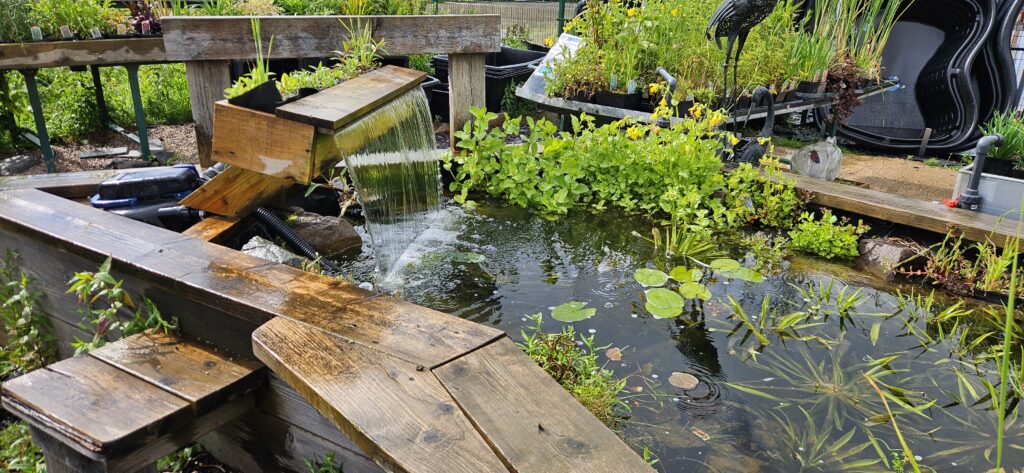
There are genuine, tested products that help with green water. I sell them. I’ve been selling them for decades. And not one of them will clear a pond in 24 hours, because no honest manufacturer would make that claim.
UV clarifiers are the most effective long-term solution for green water caused by suspended algae. A good UV system, correctly sized for your pond volume and flow rate, will typically clear green water within a week to ten days. The key word there is “correctly sized.” An undersized UV running at too high a flow rate won’t do the job. A bulb that’s been in place for more than a year may not be performing at full output even if it still glows.
Flocculants can work over time by clumping suspended particles together so your filter can remove them. They are not instant, and they are not a standalone solution. They work best alongside good filtration, not instead of it.
Beneficial bacteria treatments help establish and support biological filtration. Again, these work over weeks, not hours, and their effectiveness depends entirely on the conditions in your pond.
Shade and plant coverage address the root cause in ponds where sunlight is a primary driver. No amount of product will solve a green water problem that’s fundamentally about too much light and not enough competition for the nutrients algae thrive on.
If someone is selling you a single product that replaces all of the above, regardless of your pond size, your fish load, your filtration, or your water chemistry, be sceptical. Ask questions. Ask for evidence. Ask whether the company behind it will still exist next year.
The Red Flags: A Quick Reference #
If you’re looking at a pond product online and you’re not sure whether to trust it, here are the things that should give you pause:
- Claims of results in 24 hours or less
- Before-and-after images that look AI-generated or too perfect
- Reviews that disappear, fluctuate, or read identically across different posts
- Credentials or research institutions you cannot verify with a search
- No identifiable manufacturer, retailer, or person you can hold accountable
- A country of origin that changes depending on which version of the advert you’re looking at
- A demonstration that uses still water in a small container to prove what a product will do in thousands of litres of moving pond water
None of these things means a product is definitely worthless. But they do mean you should do more digging before you hand over your money. Research the company and product using sources you trust

The Honest Answer: What Will Actually Clear Your Pond #
There isn’t a single answer, because there isn’t a single cause. But there is a process.
If it’s a natural pond with no circulation, then you can use organic products from trusted sources like ECO-treat clarity. Any of these products will take longer to work, but they will move your pond in the right direction, their price remains constant and you can contact both the manufacturers and us.
For filtered ponds start with your basics. Is your filter the right size for your pond and fish load? The filter may have been good enough when you bought it but fish grow and produce more waste. Is your UV bulb less than a year old? Is your flow rate through the UV slow enough to be effective? Is your pump drawing water from the right part of the pond?
Get those right and most green water problems resolve themselves within a few weeks without any additional products at all.
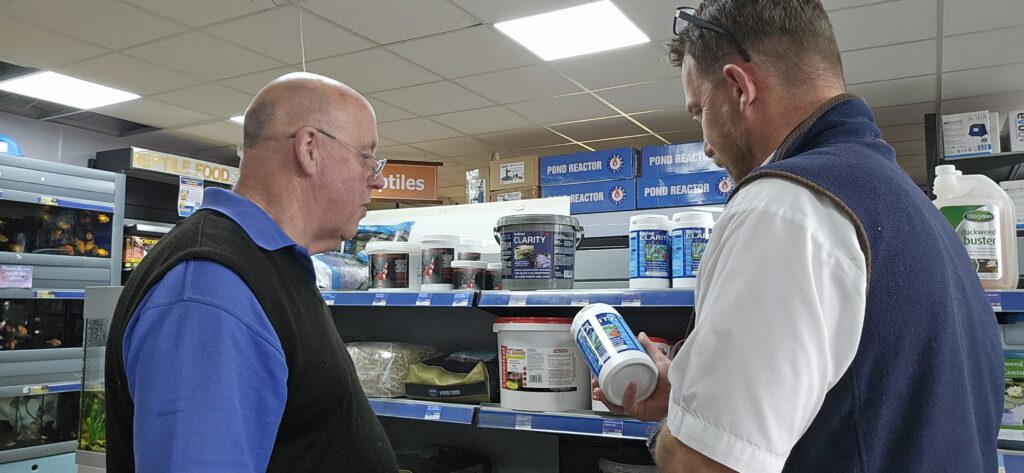
If you’ve checked all of that and you’re still struggling, come in and talk to us. Bring photos if you can. Tell us how long the pond has been running, how many fish you’ve got, and what filtration you’re using. That conversation, with someone who actually knows ponds, will get you further than any 24-hour guarantee.
And if you’ve already bought one of these products and it worked for you, genuinely: I’d love to hear about it. My email is on the website. I’m not in the business of being closed-minded. I’m in the business of telling you the truth, and right now, the truth is that the evidence points firmly in one direction.
Pragmatic Summary #
- Miracle pond-clearing products sold through social media adverts carry multiple red flags: fake reviews, unverifiable credentials, AI-generated content, and claims that contradict basic pond biology
- The powder is almost certainly a cheap flocculant, aluminium sulphate or similar, available in bulk for pennies and sold at a significant markup in unbranded packaging
- Flocculants work in a jug of still water. They do not solve green water in a living, circulating pond, and aluminium-based compounds may affect water chemistry in ways that matter for fish
- No legitimate product will clear a green pond in 24 hours, because pond biology doesn’t work that way
- Every pond is different. The right treatment depends on your filtration, your fish load, your UV, your sunlight levels, and your water chemistry
- Real solutions (UV clarifiers, proper filtration, plant coverage) take days to weeks, not hours
- Before buying any pond treatment, check who’s behind it, whether the claims are verifiable, and whether anyone with actual expertise backs it up
- When in doubt, talk to a human who knows ponds. There are thousands of people in the UK who have a good knowledge of ponds, some of their ideas may differ, but they might just be able to steer you in the right direction.
Richard Cook is the Managing Director of Shirley Aquatics, a family-run aquatics business that has been serving fishkeepers since 1939. A third-generation aquatic retailer with over 35 years of hands-on experience, Richard is the voice behind The Pragmatic Aquarist, known for his honest, no-nonsense approach to fishkeeping advice that helps customers make confident decisions that work in the real world, not just on paper.


