


Sub-Total: £0.00
How do you best look after your pond in winter?
16 min read
Table of Contents
How to look after your pond in winter, the big Do’s and Don’ts! #
This is a pragmatic look at what you COULD do with your pond. There are a lot of common mistakes, some of which have been passed down over the decades. As well as a lot of easy wins. Looking after your pond correctly in winter can have some major benefits. Whilst falling into some of these age-old habits could have repercussions that last well into the summer!
This guide is not about perfection.
It’s about practicality, picking your battles, and helping your pond survive and thrive through winter realistically, affordably, and without guilt.
A Pragmatic Aquarist’s Handbook with real-world applications for looking after your pond in winter

Foreword: From The Pragmatic Aquarist
Welcome to this winter pond care guide!
This guide is for you to use/not use, adapt or ignore. I can only offer best practices and some solutions to problems you may not have even thought of as problems, like why aren’t my fish hungry at the moment?
Read more from me:
Written not by a biologist in a lab coat, nor a mystical koi whisperer, but by someone who has spent decades helping real people avoid real problems in real ponds. Someone who has thawed frozen pipes, replaced fractured quartz sleeves, diagnosed mysterious winter fish deaths, and comforted more distraught pond-keepers than I can count.
If you’re anything like me, you’ve probably learned much of your fishkeeping wisdom through trial, error, and the occasional “that seemed like a good idea at the time…” moment. That’s the heart of what I call The Pragmatic Aquarist approach: yes, there are a few hard rules but beyond those, fishkeeping must fit around your life, not take it over.
I can only offer best practices, not commandments.
And yes, you might have a routine that has worked “perfectly fine for years”…
until the day the perfect storm arrives the one winter where all the little things you have or haven’t been doing suddenly pile up and put you in a spot of aquatic bother.
Even small tweaks in the right direction can make a massive difference when winter hits hard.
To paint the picture of the Pragmatic Aquarist mindset, I read a comment recently on Facebook where someone innocently asked for a bit of advice. Immediately, the voice of god descended:
“A KOI POND SHOULD BE 8 FEET DEEP AND HAVE AT LEAST TWO BOTTOM DRAINS.”
Alright then, Mr Koi-God. Yes, in an ideal world, perhaps.
(Although let’s be honest — an 18” koi looks more like 12” when you’re peering down into an 8ft abyss.)
But not everyone can build a pond like that.
Part 1 — The Most Common Winter Pond Mistakes
Winter is when ponds are at their most vulnerable.
Cold water, reduced fish metabolism, slower bacteria activity, increased rainfall, and increased debris all combine to create the perfect conditions for trouble… unless you know what to look out for. But it’s also when we spend the least time around our ponds. So how do you best look after your pond in winter? The damage done in winter is not always immediately apparent. Fish and the pond ecosystem as a whole can be weakened, and it’s not until spring that things really fall apart…The ripple effect I suppose!
1: The Famous Football on the Pond
In the first home I can remember I must have been four or five I recall my dad placing a football on the pond at the bottom of the garden in winter
Yes… John Cook. “The Founder.”
(👼 cue angelic AHHHHHHHHHs)
Dad meant well. Lots of people did (and still do), but that was the late 70’s and now we know better!
The idea was that the ball would stop the pond freezing over completely. You can remove the football to create that ice free space (news flash…most people forgot this part)
A football does not prevent freezing or maintain gas exchange by allowing oxygen in or removing harmful gasses from the pond.
But it does roll about looking helpful, like a floating lifeguard on tea break, until the water freezes, then it just becomes part of the problem
2: Turning the Pump Off
Fish slow down in winter, but they don’t stop needing oxygen.
Your pump is the heart of your pond’s ecosystem. It keeps oxygen circulating, waste moving, and beneficial bacteria alive.
Turning it off shuts down:
- Oxygen delivery
- Circulation
- Biological filtration
- Ammonia conversion
- Winter protection
It also means you’ll need to “reboot” the entire filter system in spring which is when your fish are at their weakest.
3: Raising the Pump Off the Bottom
At some point, a myth started circulating that ponds should have their pumps “lifted up” in winter.
Your pump does not need protection from cold water! in fact, it’s designed for it.
But your fish do need protection from stagnation at the bottom of the pond.
Lifting your pump:
- Reduces circulation where fish are living
- Reduces oxygen delivery
- Allows stale layers to build
- Increases risk of winter/spring deaths
4: Skipping Filter Maintenance (AKA Skipping Leg Day)
Skipping filter maintenance in winter is easy to do, just like not going to the gym for three months.
Winter filter maintenance is very much like going exercising, it’s something we should do regardless of the weather. Yes, fish produce less waste in winter, but nature produces plenty:
- Leaves
- Twigs
- Mud
- Algae die-off
- Dust
- Storm debris
- Sludge build up (algae, blanket weed & duck weed food to you and me)
Your filter should not be ignored in winter. It only pushes the problems through into next spring & summer.
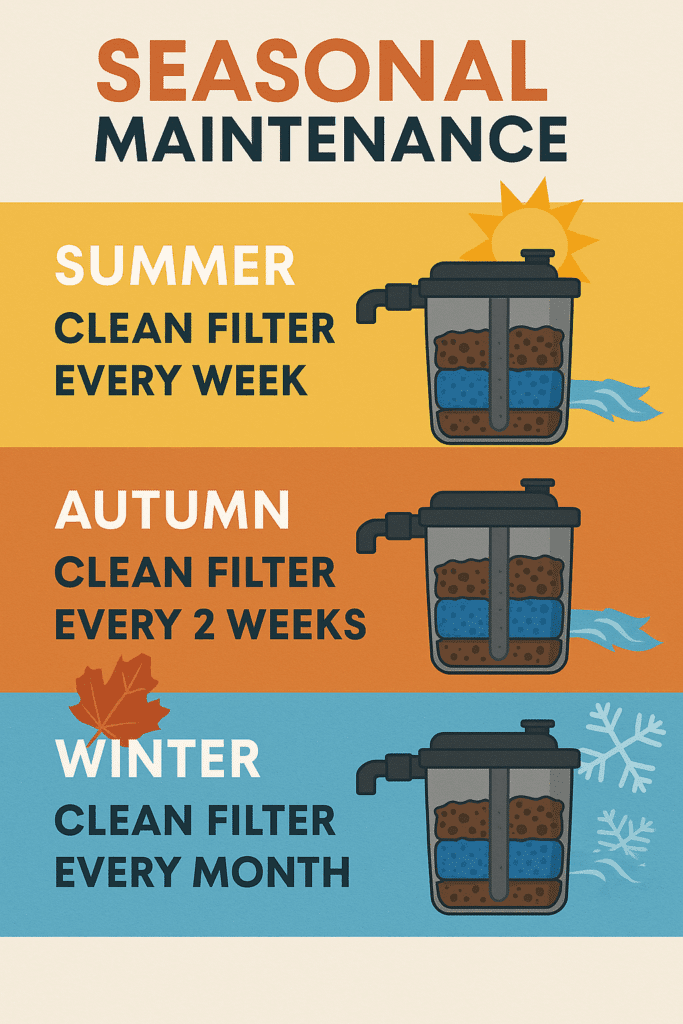
Sludge busting products are really helpful, but remember, they are biological, so their actions will be limited when pond water temperatures are at their lowest
Regular filter maintenance:
✔ Prolongues pump life
✔ Prevents clogs
✔ Maintains oxygen levels
✔ Stops toxic anaerobic sludge
✔ Supports beneficial bacteria
✔ Prevents ammonia spikes
5: Ignoring Water Tests — Especially KH
Regular water testing is your early warning system. Your water maybe crystal clear, but that is no indication that it is healthy. Every spring, I meet people heartbroken because they’ve lost one or several large fish seemingly without warning. One by one, the fish roll over and die. Quietly. Mysteriously.
And it’s almost always the same problem. Their pH is very acidic and their ammonia is sky high. These two problems are linked and would have crept up slowly over winter.
A winter KH crash → pH crash → ammonia spike → acidosis → fish deaths.
Contributing factors to winter crashes are:
- You live in a soft water area
- Your pond tops up mostly with rainwater
- Leaves accumulate
- KH drops to zero
KH is the buffer that stops your water turning acidic.
Without KH, your pond becomes chemically unstable. The good bacteria can’t function properly, waste builds up & your fish can’t export toxins from their system
6: Feeding Fish Normally in Winter
Between 10°C and 6°C, fish can’t easily digest high protein summer foods. Below 6°C, fish cannot physically digest food at all
Anything eaten will sit in their gut, Rot and create health issues.
7: Letting Leaves Build Up
Leaves don’t just look messy — they actively make winter harder.
They:
- Lower KH
- Lower pH
- Consume oxygen
- Add extra bio-load
- Decompose into sludge
8: Not feeding at all
Whilst you shouldn’t feed below 6 degrees, there are plenty of foods fish can digest above this temperature, feeding the right food at the right time can give your fish the stamina they need to get through the winter and come out fighting in spring
Part 2 Doing Winter the Right Way
1. Meet CAPTAIN KH — Your Pond’s Unsung Hero
🦸♂️ Protector of pH! Slayer of Sludge! Abolisher of Ammonia!
When the nights grow cold and the filters slow, one unseen hero keeps your pond from turning into a watery wasteland — Captain KH, defender of stability and all things alkaline.
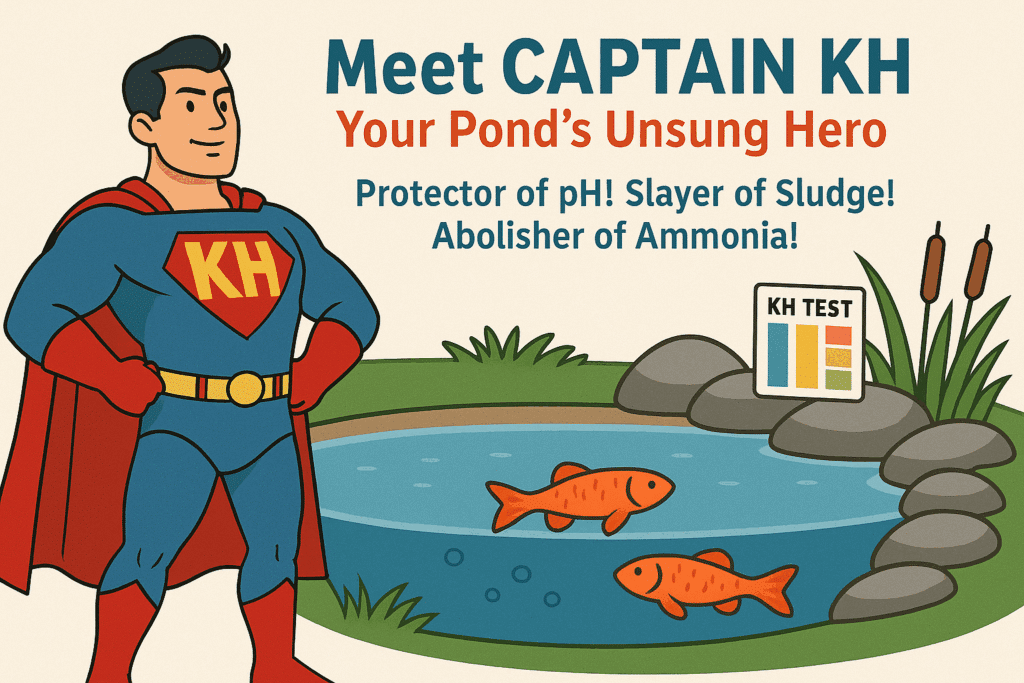
If there’s one thing you take from this guide, make it this: check your KH.
KH (carbonate hardness) is the buffer that prevents your pond from becoming acidic. When KH hits zero, winter becomes deadly.
What causes KH crashes?
- Soft tap water
- Rainwater top-ups
- Leaf litter
- Natural biological processes
- Lack of buffering minerals
- Build up of CO2
- Lack of plant and algae growth, that would normally absorb excess CO2
What happens during a KH crash?
- pH drops (sometimes to 5)
- Filter bacteria stop functioning
- Ammonia spikes
- Fish can’t excrete waste properly (acidosis)
- Fish die quietly over winter and early spring
What to do
- Test KH in autumn, winter, and early spring they are one of the easiest and cheapest tests to do.
- Add KH buffer when needed
- Keep KH consistent year-round
2. Keep Water Circulating
Your aim from late Autumn to early spring should be to reduce water contact with air. close off fountains (take off the fountain head if you need to) turn off air pumps and bypass waterfalls. Your fish need circulation, but what they don’t need is constantly changing water temperatures as a result of too much contact with air.
The worry is often that the fish won’t get the oxygen they need, we are so used to looking after them in summer with lots of splash, air pumps and Oxygen, that we tend to overcompensate in winter. Their respiration rate is at most 10% of that in the summer. They don’t need your help, really!
We all know that air temperatures can vary as much as 15 degrees in the colder months. 12 degrees during the day and minus 3 at night! You don’t get that in summer! Imagine sitting in the sauna all day, then jumping into a plunge pool overnight! bit extreme, but you got the picture
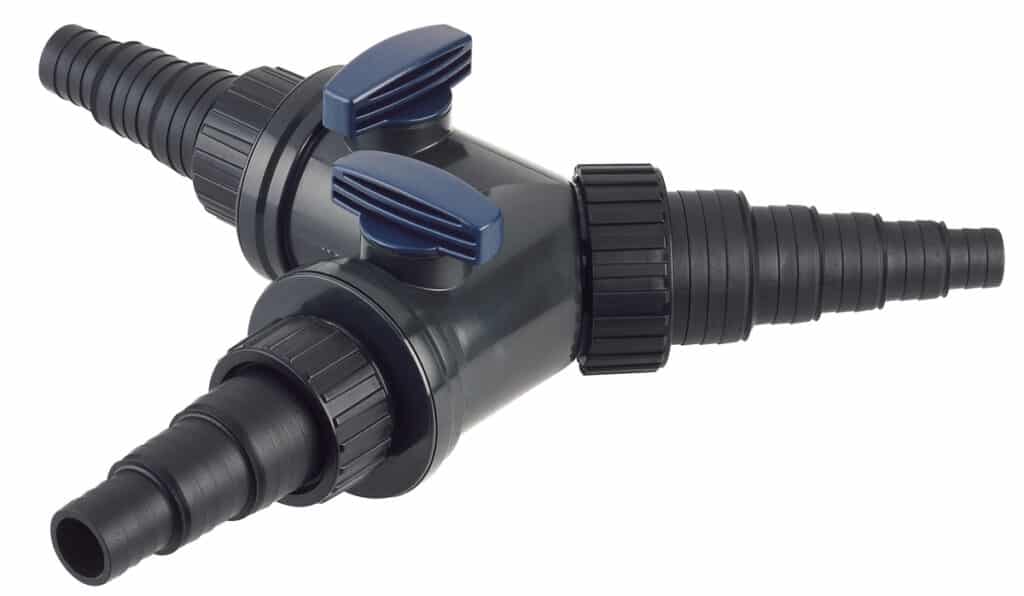
If you have a waterfall, it acts like a reverse radiator in winter rapidly cooling a thin layer of water as it mixes with cold air.
A simple bypass pipe lets you divert water straight back into the pond during winter and reopen the waterfall in summer. You can easily fit a divertor valve and bypass pipe either during construction. This has the added bonus of allowing you to get the perfect flow of water down your waterfall without putting back pressure on the pump.
B. Adjust your return flow
In the summer you want as much splash as humanly possible. In winter you want to have any return pipes below the water surface. Aim for around 6 inches below which will still give you more than adequate circulation and oxygenation but reduce the affect of cold air temperatures on your pond.
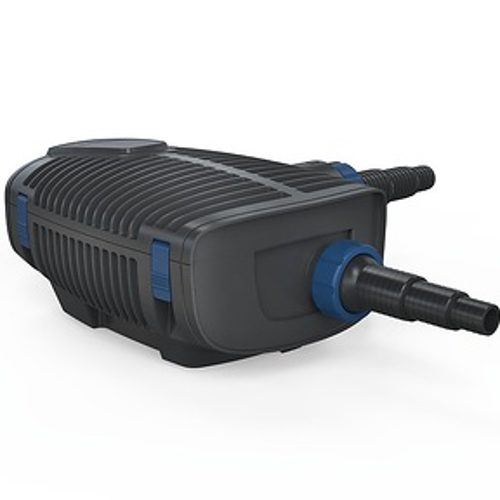
Richard’s notes: Everyone is understandably worried about running cost, and it’s often one of the reasons stated for switching pumps off in winter. But, when you factor in the knock-on effects the following year, water treatments, fish treatments and extra visits to your favourite aquatic superstore, it’s false economy. Plus Some modern pumps are sooooooo much more efficient! If you have one great, if not, it’s worth looking into. Switching to an energy efficient pump that regulates it’s own flow in winter can easily save you £80-£200 a year in running costs!
3. It’s Just a Hole in the Ice, Man — How Difficult Can It Be!
A frozen pond looks peaceful… but beneath that lid, gases build up and oxygen levels fall.
Your goal is simple:
keep one small area ice-free for gas exchange. You only need a hole about the size of a dinner plate, you’re not expecting a submarine to surface. Just enough for oxygen to get in and noxious gasses to escape.
Ways to do it
- Use a small pond heater or floating de-icer. Remember, these only need to be turned on, when the air temperatures are due to fall below freezing. You don’t need them on all the time, you’re just throwing money at the energy companies if you do that!
- Float a piece of polystyrene with a hole cut in it (you’ll need to keep an eye on this one)
- Create a gentle surface ripple with your pump return.
- Adding salt to your pond in winter can have a number of benefits, including, reducing the risk of freezing. Consult one of our team before doing so.
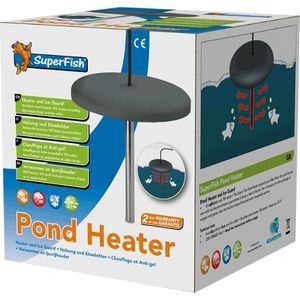
Whatever you do, don’t smash the ice. It sends shockwaves through the water, unnecessarily stressing fish.
💬 Richard’s Challenge:
Come on, you ingenious wannabe Blue Peter badge owners! If you’ve got a creative way of keeping that blowhole free in the heart of winter, let me know and I’ll happily include it in this guide.
But for now, here are some handy tips…
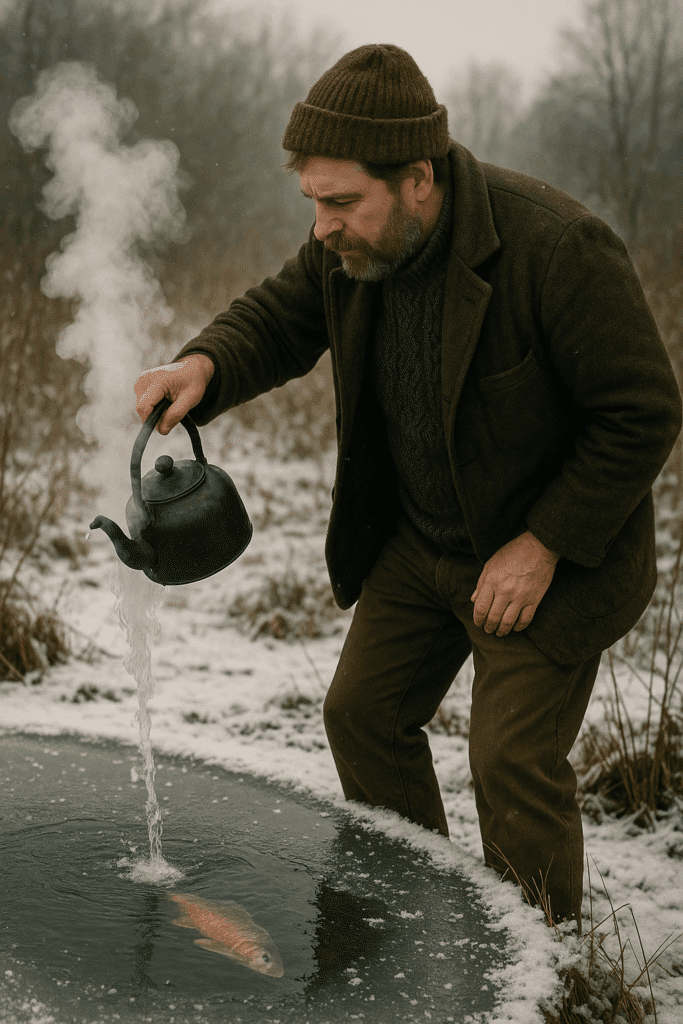
Hot tip: If you need a hole quickly, rest a jug of hot water on the ice and let it melt through naturally.
4. Feeding Through Winter — Less Is More
Feeding fish in winter isn’t about affection — it’s about temperature and timing.
When water drops below 10°C, your fish’s metabolism slows.
Below 6°C, it practically shuts down.
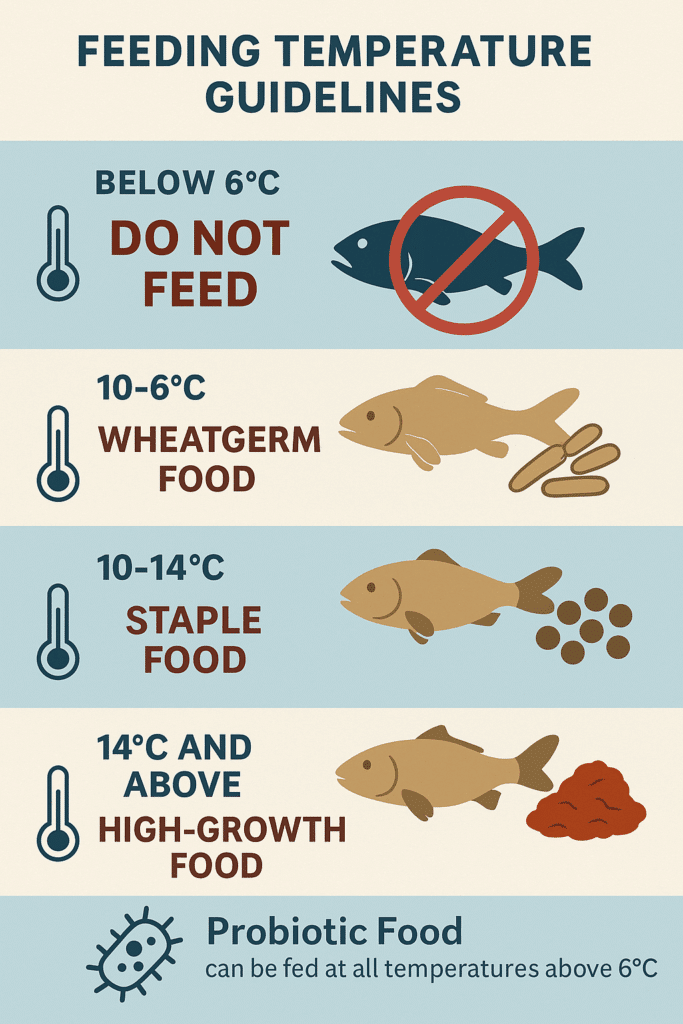
Your winter feeding guide
- Above 10°C → Normal feeding, but smaller portions
- 6–10°C → Switch to wheat germ/probiotic wheat germ. It’s a fatty food that is easier to digest at lower temperatures. Any food that is easier to digest, means the fish has to expend less energy doing so.
- Below 6°C → STOP feeding.
Don’t feel guilty if you skip a feed. Fish don’t run on schedules — and unlike my teenage kids, they won’t starve if they miss a meal, they could also be just as finicky! Flake foods are not really a good choice for lower temperatures. Your slow-moving fish won’t often get to the flakes before they disintegrate. There is also no option for a wheat germ flake food.
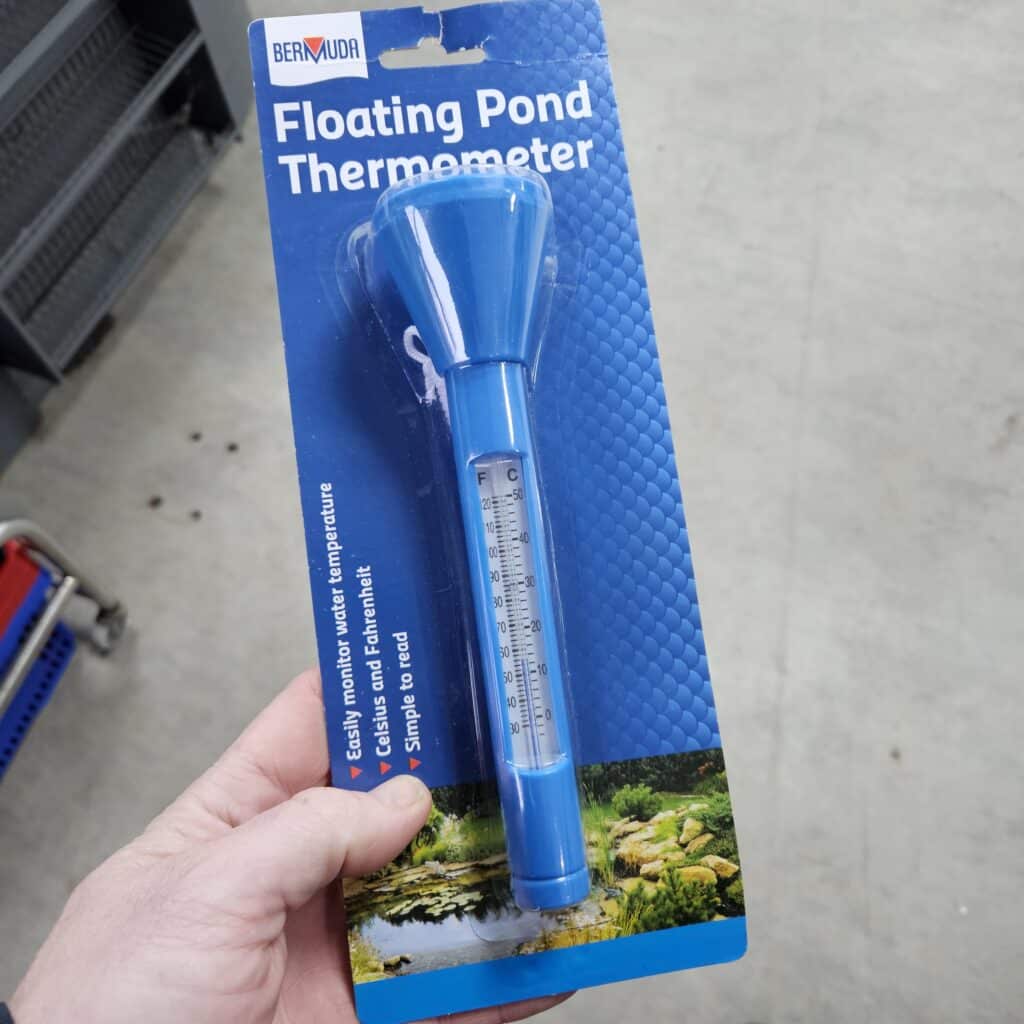
Hot tip: Use a pond thermometer. They really aren’t expensive and it removes the guess work! “Feels cold” is not a measurement — even if your toes disagree. You can adjust your feeding, knowing that you’re doing the right thing
5. Insulate where you can
Some people think about heating their pond. Ron, one of our Koi experts and Koi show winner, heats his pond all year round. But, he has taken insulation to the extreme and built a conservatory over his pond! You don’t have to go this far, and I would think long and hard before considering heating your pond, it isn’t necessary and it is most definitely costly.
You can:
- Properly bury or lag your pipes
- Wrap your filter in insulation or even bubble wrap
- Create an insulated cover or frame over the pond.
- If you can’t bypass, then cover your waterfall with a layer of bubble wrap or similar
Richard’s notes: You’re not actually aiming to raise your winter temp at all with all of this insulation. What you are trying to do is take away the sharp changes in temperature that can happen, especially in late autumn and early spring. Sunny days: pond warms up, Frosty nights: pond cools down. Fish don’t mind warm water they don’t mind really cold water. Yo-yoing between warm and cold is what causes the damage and impacts on their immune system. Carp pox ( waxy lumps) is often a sign that temperature variation is having an effect on your fish.
6. Leaves, Nets & Autumn Prep
Leaves aren’t just a visual annoyance — they actively damage winter water quality.
As they decay, they:
- consume oxygen
- lower KH
- lower pH
- increase sludge
- increase ammonia
- contribute to winter KH crashes
Your options
- Cover net: simple, effective, affordable
- Regular netting/skimming: if your pond is small
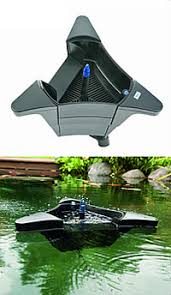
- Motorised skimmers: if you have heavy tree coverage. Easy to clean and they’re doing your work for you
- Full pond covers or frames: for vulnerable ponds
Anything that reduces leaf debris will dramatically improve winter survival rates. Of course cover nets also offer protection against another winter problem, Herons! So as ugly as they are, they are often neccessary.
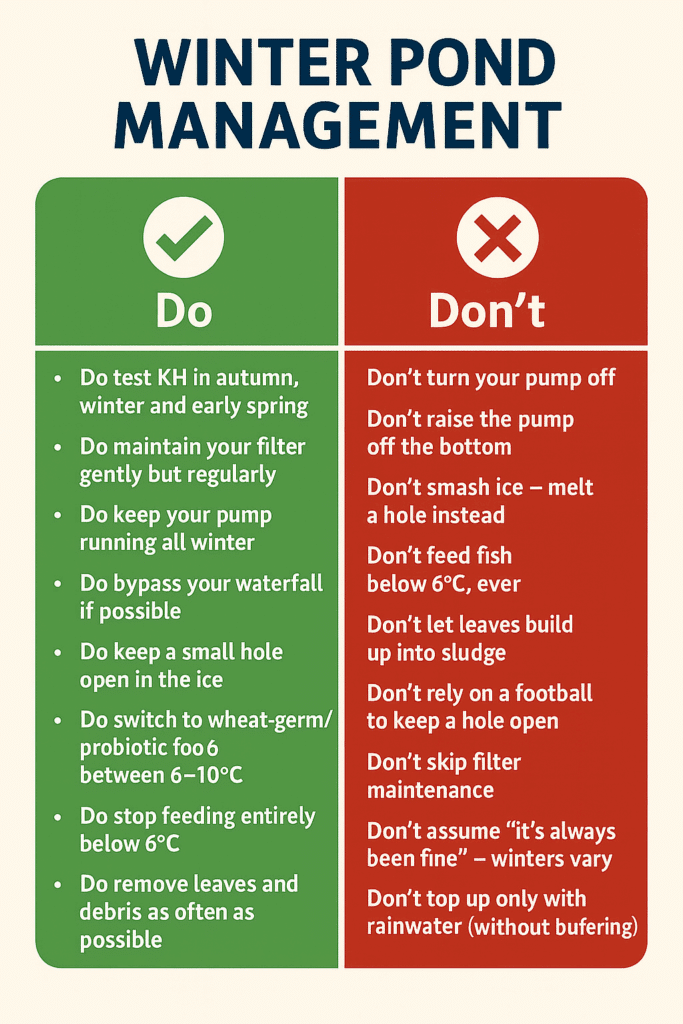
Winter Pond Care: Do’s & Don’ts
It’s a “could do” rather than a “should do”
This is just a guide, a list of best practices. There are people who do all of these things, there are people who do none of them and haven’t had issues (yet).
I don’t know what the next winter will be like, but I do know, without fail, we will be getting customers in January who have lost fish, which wouldn’t have happened if they had taken at least some of this advice. That doesn’t mean I will dance around saying “ I told you so” I will give them the exact same advice in an effort to stop the same thing from happening again the following year.
One final thought: I know all to well, that life gets in the way. I know exactly when I should bypass my waterfalls, and start feeding wheatgerm…Invariably, I miss these deadlines and even forget to do some of these recommendations. The advantage I do have, is that I know what to look for and can quickly identify the cause of a problem. Essentially, I can be very good at backpedalling when I need to. Hopefully having read this article, you are also in the same position; you have all the knowledge to act before the wheels fall off, or at least catch them before they hit the ground!


