


Sub-Total: £0.00
How Much Does It Cost to Build a Koi Pond?
10 min read
Table of Contents
- What You Can Expect from This Article
- 1. The Quick Answer: Average Koi Pond Costs
- Why Some Koi Pond Builds Cost £20,000+
- Why Some Koi Ponds Cost Under £1,500
- 📊 Koi Pond Cost Spectrum
- What Drives the Cost?
- Hard Pipe vs Flexible Pipe
- Long Term Running Costs
- Example 10,000 Litre Pond Budget
- Where Shirley Aquatics Typically Lands
- Final Thoughts
(The Pragmatic Aquarist Chronicles: Real-World Answers for Everyday Fishkeepers)
Building a koi pond is one of the most rewarding projects a fishkeeper can take on but it’s also one of the biggest investments. Whether you’re planning a small ornamental feature or a show-grade koi pond, understanding the real costs involved can help you plan your budget (and avoid costly mistakes later).
I’ve had a koi pond in every house I’ve ever lived in, from a massive (almost lake-like) pond my dad built in our beautiful back garden in Penkridge, to a modest inherited pond in the first house Sarah and I bought, and finally the pond I have now.
That first pond was something special. The garden actually had a brook running through it, so Dad devised an ingenious system of locks to perform water changes… until freak flooding overflowed the pond entirely and washed his beloved koi downstream! The next pond was far more traditional, while the one I have now was never even meant for koi at all, it was designed to be a gentle feature full of plants and movement.
And then my daughter said she wanted some koi.
Plans change. Things evolve. We grow. We learn.
That’s really what fishkeeping and this article is all about.
What You Can Expect from This Article #
If you’re thinking about building a koi pond, whether it’s your first or your fifth, this article will walk you through everything you need to know before you start digging.
Here’s what we’ll cover:
- Real-world koi pond costs range from small starter ponds to professional show ponds.
- What drives prices up and down are materials, equipment, filtration, and features.
- How to balance budget, enjoyment, and maintenance (your EMR Enjoyment-to-Maintenance Ratio).
- Historical price trends: what’s changed and why.
- Financing options for when you’d rather spread the cost.
- DIY vs professional installation: what to expect from each.
- Price FAQs: the quick answers every buyer wants to know.
Whether you’re working to a tight budget or aiming for your dream setup, by the end of this article, you’ll know exactly what goes into the cost of a koi pond and how to make sure it’s money well spent.
1. The Quick Answer: Average Koi Pond Costs #
- Small garden koi pond (1,000–2,000 litres): £1,000–£3,000
- Medium koi pond (5,000–10,000 litres): £3,000–£8,000
- Large or professional-grade koi pond (10,000+ litres): £8,000–£20,000+
These figures include materials and equipment but not heavy landscaping or luxury features like glass viewing panels, computer monitoring or automation.
Why Some Koi Pond Builds Cost £20,000+ #
High-end builds usually include:
• Bespoke concrete construction
• Render and fibreglass finish
• Drum filtration
• Multiple bottom drains
• Premium low-wattage pumps
• Viewing windows
• Heating systems
• Full landscaping
• Professional installation
A professionally installed concrete pond with drum filtration can reach £10,000 to £15,000 before landscaping even begins. Generally speaking, ponds at this end of the cost scale are larger in volume and 1.8m-2m deep
Expensive does not mean excessive. It often means permanent, efficient and low maintenance.
Why Some Koi Ponds Cost Under £1,500 #
There are a number of ways you can keep the cost of a pond build down; they don’t have to cost the earth. There are also options to upgrade later. SO have a think about what is really critical at this stage, and possibly what you might be kicking yourself for doing in 2 years time:
• Shallower
• Flexible liner builds
• No bottom drain (saves around £500 on pipe work)
• Basic filtration (can even be home-made, but just check how much of your time it will cost you to maintain & possibly build in the first place)
• Higher wattage pumps-it’s an easy way to keep the initial cost down, but cheaper pumps are pretty much always more expensive to run. Check the wattage and remember every 10W costs you £20/year (correct at time of publication)
• DIY- Doing the work yourself keeps costs down significantly.
Richards Tip:
If you are getting your pond built professionally, check what pump they are going to instal. In our experience it’s often the cheapest that is chosen to keep the budget down. Pond builders generally don’t worry about the running cost of the pump. Making the right decision early on can save you A LOT of money in the long run. Cheaper pumps also only come with a three year ( or less) warrantee, so ask the question when you get the quote and research that pump. Again, every extra 10w per year is another £20 in the energy companies pockets!
You might assume a raised pond is cheaper because there is less digging. Sometimes that is true. But raised ponds require bricks, blocks or sleepers. You remove the soil cost and replace it with the material cost.
It does not necessarily remove cost, but may very well save a lot of time
Think about reducing the size if you need to economise rather than compromising on some of the key elements.
Start off by looking at the manufacturer’s recommended pond size for the type of filter you are interested in. You can then adjust your planned volume so you don’t end up needing the next model up.
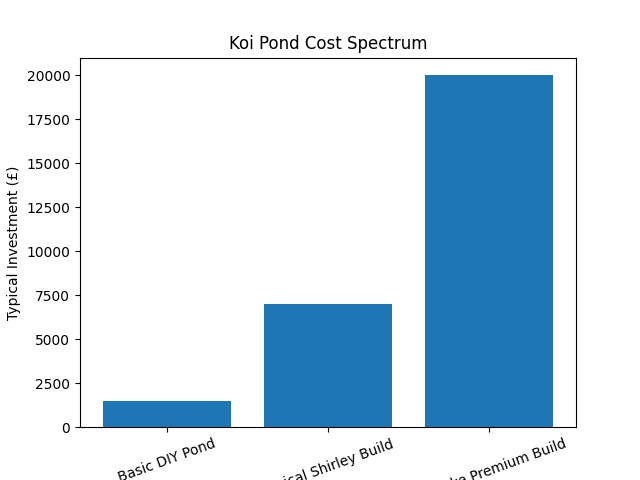
📊 Koi Pond Cost Spectrum #
The following visual shows how investment levels typically compare:
Basic DIY Pond around £1,500
Typical Shirley advised build is around £4000-£7,000
Bespoke Premium Build £20,000+
What Drives the Cost? #
Size matters! #
Of course, the elephant in your garden is how big you will make your koi pond? This will dramatically affect your budget and quite possibly your relationship with your partner! Many heated words have been shared in our store over the pond, taking up too much of the garden! But please look into the costings thoroughly. 1000 litres or a metre here or there can affect the size of the filter you need and how much lining. You may even find you can go slightly bigger than you thought, because the filter in your bracket will allow it.
Construction Type #
Preformed ponds are durable and simple but limited in size.
Flexible liners are cost-effective and adaptable, but folds are unavoidable when fitting a flat sheet into a three-dimensional hole.
Box weld liners offer a neater finish at a higher cost.
Concrete ponds are the ultimate option. You can finish with fibreglass for a premium result or render and pond paint for a more cost-effective approach.
For a deeper breakdown, see:
Filtration and Your EMR #
Filtration has the biggest impact on both cost and enjoyment.
I call it your EMR. Enjoyment to Maintenance Ratio.
| Filter Type | Typical Cost | Maintenance Intensity |
|---|---|---|
| Box Filter | £100 to £500 | Very High |
| Pressurised | £300 to £1,000 | High |
| Nexus | £400 to £1,200 | Medium |
| Bead | £800 to £1,500 | Low |
| Drum | £1,500 to £4,500 | Very Low |
The easier a filter is to maintain, the less time you spend on it and, critically, the more likely you are to clean it regularly! All of this adds to your pond enjoyment. You don’t have to go all in feet first with a £3k drum filter, just choose wisely and think about the maintenance.
Bottom Drains #
Bottom drains remove waste efficiently and improve circulation. They must be installed during construction and require the top of the filter to sit inline with the top of the pond
They are not mandatory for every build. They are the best way of moving dirty water from your pond to your filter, but not the only way, and sometimes it is just not possible
If you choose not to install one, you can compensate by increasing pump flow and adjusting return positioning to aid circulation and keep debris suspended long enough to reach the filter.
Hard Pipe vs Flexible Pipe #
This is not glamorous. But it matters.
Flexible pipe is:
However flexible pipe can restrict flow slightly over distance, is harder to modify neatly later and can look untidy if poorly routed. It can also become brittle over time. It is:
• Quick to install
• Forgiving
• Cheaper initially
• Ideal for getting a pond up and running quickly
Hard pipe systems with proper elbows, valves and manifolds:
• Costs more upfront
• Takes longer to plan
• Require accurate measuring & use of solvents for cleaning and glueing
• Add significant material cost
But they offer:
• Better long-term durability
• Cleaner flow control
• Easier isolation of components
• Simpler future upgrades
• A far neater professional finish
Richard’s Tip:
There is also something deeply satisfying about a clean, hard pipe setup. It almost becomes part of the engineering beauty of the pond. A work of art in some cases! ( yes I am a little weird!)
A pragmatic approach is to start flexible if the budget is tight, then upgrade sections to hard pipe over time.
Long Term Running Costs #
Running cost is where many pond owners get caught out.
The pump runs 24 hours a day. Efficiency matters. It is an important fact to know when dealing with your household bills.
Aquamax Eco Premium Example #
These pumps may look expensive initially, but they can save over £800 in electricity over 3 years compared with less efficient alternatives.
Using 0% finance to invest in efficiency can be one of the smartest decisions in the build.
Richard’s Tip: Do Not Skimp On The Pump. #
The pump is the heart of the system.
It is often chosen last when budgets are tight.
A three-year warranty pump is statistically more likely to fail than a five-year model.
We have seen cases where spending £300 more initially saved over £800 in electricity within three years. I have even had people using a pump from Screwfix for £60 (bargain!!!), only to realise that is costing…wait for it £1500 per year to run!!!
You can compromise on lighting.
You can compromise on edging.
Do not compromise on the pump.
Typical Pond Pump Running Cost Comparison #
| Pump Model | Initial Purchase Price | Output | Estimated Annual Running Cost |
|---|---|---|---|
| Screwfix Titan | £59.99 | 14,000 LPH | £1,500 |
| Hozelock Aquaforce | £290 | 15,000 LPH | £360 |
| Pontec Pondomax 14000 | £200 | 14,000 LPH | £280 |
| Oase Aquamax Eco Premium 13000 | £600 | 13,000 LPH | £146.60 |
Figures based on electricity cost and purchase price at the time of publication.
Efficiency wins over time.
Example 10,000 Litre Pond Budget #
| Item | Estimated Cost |
|---|---|
| Liner and Underlay | £500 |
| Pump and Filter | £1,000 |
| UV and Air | £400 |
| Pipework | £200 |
| Electrical | £250 |
| Landscaping | £600 |
| Koi and Food | £600 |
| Total | £3,500 to £4,000 |
Where Shirley Aquatics Typically Lands #
Most Shirley Aquatics customers invest between:
£3,000 and £10,000 #
Depending on:
• Size
• Filtration
• Pump efficiency
• Bottom drain inclusion
• DIY or professional install
Professional builds typically add 20 to 30 per cent.
The perfect pond is not the most expensive one. It is the one that fits your life.
Hidden costs
It’s easy to get carried away in all the excitement, but there are some hidden & long term costs you might need to think about. It’s worth exploring these, especially when deciding on which pump, lining, filter etc.
- Pump Running cost ( I think I have covered that one!)
- Water changes ( roughly 10% per month). Are you on a water meter?
- Insulation & heating, especially important for raised ponds. Consider using sheet insulation during construction to improve temperature stability
- Insulation, a cover! Most heat is lost through the surface in winter
- UV Bulb replacements should be done annually (more efficient bulbs may go a few months longer)
- The type of soil. Clay soil will increase excavation costs
- Weather. The time of year will dictate how long the project takes, and labour costs may go up
- Tap water purifier (essential in my book!) is far cheaper than dechlorinating chemicals.
- Heron prevention. Worth thinking about some form of physical barrier in the early stages
- Filter media. Some filters require annual media replacement
- Water treatments. Adding minerals is often essential (budget £20/month)
- Medications. Prevention is always better than cure, but fish WILL get sick (sorry/not sorry)
- Fish food. Buy the best you can afford. Cheaper foods create more poo, which equals more work
- Blanket weed. The scourge of every pond keeper! Dose with a preventative like eco treat clarity from day one, and you will never know the pain!
Life time cost over initial cost:
“Over five years, a £4,000 well-built pond often costs less overall than a £1,500 pond upgraded in stages.” It’s worth thinking about every angle you can initially. You will definitely get blind sided at some point, but you will be better prepared!
Final Thoughts #
Is it worth it?
From a purely financial perspective, probably not. A koi pond is unlikely to make you money, and while a well-designed pond can add character to a garden, that is rarely the real reason people build one.
People build koi ponds because of what they add to everyday life.
There is something calming about standing beside a pond and watching the fish move through the water. It slows you down and gives you something living to care for and improve over time.
And that is the key point.
A koi pond is never really finished. Most keepers are always thinking about the next improvement.
Pragmatic Aquarist Insight
I have rarely met a koi keeper who is completely satisfied with their pond. Not because it is bad, but because the next idea is already forming.
shirley aquatics 1984 Ltd
Becketts Farm
Wythall
0121 744 1300
sh**@****************co.uk


