

Sub-Total: £0.00
Heads up! Livestock sells out quickly — please give us a quick call before visiting to check availability.
Venustus Hap
Price range: £8.99 through £31.44
Care Level: Easy
Max Size: 28cm
Diet: Omnivore
Temperature: 24-26°C
PH: 7.5-8.5
Temperament: Somewhat Aggressive
Purchase Size: 6-7cm
Description
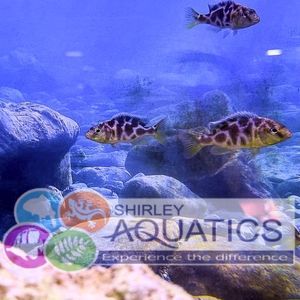
Venustus Hap (Nimbochromis venustus)
The Venustus Hap (Nimbochromis venustus), sometimes known as the Giraffe Cichlid or Giraffe Hap, is a large and impressive predatory cichlid from Lake Malawi. Their distinctive yellow and brown blotched pattern gives them their common “Giraffe” name, while mature males can develop spectacular blue colouration across the head and body.
Venustus are relatively peaceful by the standards of large predatory Malawi cichlids, but don’t let that description fool you. These are powerful fish that can exceed 20cm in length and will readily eat smaller tank mates. They are best suited to large Malawi aquariums alongside robust species that are too large to be considered food.
Venustus Hap Set Up
Venustus require a large aquarium with plenty of open swimming space. We recommend an aquarium of at least 150cm (5ft) in length for adults, with larger tanks strongly preferred when keeping a group or mixing them with other large Malawi cichlids.
Sand makes an ideal substrate and allows the fish to display more natural behaviour. Rockwork can be used to provide territories and visual barriers, but we would leave considerably more open swimming space than you might provide in a typical Mbuna aquarium.
Like other Lake Malawi cichlids, Venustus prefer hard, alkaline water and require powerful biological filtration. Their eventual size and appetite mean they produce a considerable amount of waste, making regular water changes particularly important.
Behaviour
One of the most fascinating things about Nimbochromis venustus is its natural hunting behaviour. In the wild, Venustus are ambush predators and have been observed partially burying themselves in the substrate and remaining remarkably still while waiting for smaller fish to approach. When potential prey comes within range, they rapidly strike.
This behaviour explains why their relatively calm appearance in an aquarium shouldn’t be confused with being safe around small fish. A Venustus may spend much of its time calmly cruising the aquarium without actively harassing its tank mates, but anything small enough to swallow should be considered potential food.
Males become increasingly territorial as they mature, particularly when females are present. Keeping several males together can result in considerable competition, so plenty of space and careful stocking are essential.
Tank Mates
Venustus are best kept with similarly sized, robust African cichlids that share their water requirements. Other suitably sized Haps and Peacocks can make good companions in a sufficiently large aquarium.
Avoid small fish entirely, including smaller Malawi cichlids that could eventually fit into the Venustus’ mouth. Very aggressive species can also cause problems, particularly if the aquarium doesn’t provide enough room for individuals to establish their own territories.
When planning tank mates, always consider the adult size of the fish rather than their size when purchased. Juvenile Venustus may look relatively harmless, but they grow into substantial predatory cichlids.
Feeding
Venustus are carnivorous predators and should be provided with a varied, protein-rich diet. Good-quality cichlid pellets can form the staple diet, supplemented with suitable frozen foods such as mysis, krill and brineshrimp.
Avoid routinely feeding mammalian meat or feeder fish. A varied diet of quality prepared and aquatic-based foods provides everything they require without the unnecessary risks associated with live feeder fish.
Why We Recommend Venustus Haps
Venustus are a fantastic choice for experienced Malawi keepers who want a larger showpiece fish. Mature males can be spectacular, while their unusual markings and predatory behaviour make them interesting even before they develop their full adult colouration.
What we particularly like about Venustus is that they combine the presence of a large predatory cichlid with fascinating natural behaviour. Given sufficient space and carefully selected tank mates, they can become an impressive centrepiece in a large Lake Malawi aquarium.
They aren’t a fish we would recommend simply because somebody has a Malawi tank, however. Their eventual size and predatory nature need to be considered before purchase.
Frequently Asked Questions
How big do Venustus Haps grow?
Venustus are large cichlids and adults can exceed 20cm in length, with males generally becoming larger than females. Their adult size should always be considered when choosing an aquarium.
Are Venustus aggressive?
They can be territorial, particularly mature males, but they are not necessarily relentlessly aggressive. Their bigger consideration is predation: small fish may be eaten even when the Venustus shows little obvious aggression towards larger tank mates.
Can Venustus live with Mbuna?
It is possible in some large, carefully planned Malawi aquariums, but it wouldn’t be our first choice. Mbuna tend to have different feeding requirements and can be considerably more aggressive and territorial. We generally prefer keeping Venustus with appropriately sized Haps and Peacocks.
Can I keep more than one Venustus?
Yes, provided the aquarium is sufficiently large. If keeping males and females together, a single male with several females is generally preferable to keeping multiple competing males in restricted space.
Can Venustus be kept with small fish?
No. Venustus are natural fish predators and anything small enough to fit into their mouth should be considered potential prey.
How can you tell male and female Venustus apart?
Juveniles can be difficult to sex reliably. As they mature, males usually develop much stronger blue colouration, particularly around the head, while females tend to retain more of the characteristic yellow and brown giraffe-like pattern.
Are Venustus suitable for beginners?
We wouldn’t normally recommend them as a first cichlid. Their eventual size, predatory behaviour, territorial nature and requirement for a large, well-filtered aquarium make them better suited to aquarists with some experience of keeping African cichlids.
If you have any questions about keeping the Festivum Cichlid, please contact us and a member of our team will be able to advise you.
Why not check out our photos of some of the best livestock we’ve had in store over the years!
Additional information
| Multibuy | 2 For, 4 For, Each |
|---|
Related products
-

Assorted Discus Large
Price range: £74.99 through £120.00 Select options This product has multiple variants. The options may be chosen on the product page -
Sale!
Otocinclus
Price range: £4.99 through £49.73 Select options This product has multiple variants. The options may be chosen on the product page -
24K Gold Kelberi Peacock Bass
£129.99 Read more -
Assorted Discus
Price range: £61.99 through £110.00 Select options This product has multiple variants. The options may be chosen on the product page