

Sub-Total: £0.00
Heads up! Livestock sells out quickly — please give us a quick call before visiting to check availability.
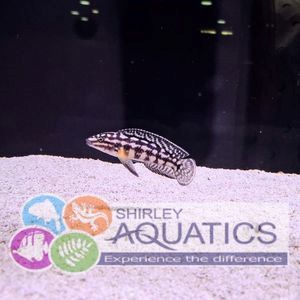
Marlier’s Julie
Price range: £8.99 through £59.73
Care level: Easy
Max Size: 13cm
Temp: 23-25°C
PH: 8.0 – 9.0
Approximate purchase size: 4-5cm
Diet: Omnivorous
Compatibility: Tanganyika Community
Minimum Tank Size: 200L
Description
Marlier’s Julie – Julidochromis marlieri
Marlier’s Julie – Julidochromis marlieri is a regional, and slightly more unusual variaton of the much loved Julie Cichlid. This is a robust and hardy species of fish that’s widespread throughout Lake Tanganyika, where it is found largely in rocky areas.
Marlier’s Julie Aquarium
The Aquarium should be fairly large and spacious to accommodate the territorial nature of this species. As with all Tanganyikan Cichlids, These Julies require very hard water, so coral sand is recommended as a substrate as it will continuously buffer calcium and KH. Additional ocean rock will make excellent rock work for the fish to utilise as their territories. There should be plenty of nooks and crannies, as well as caves to help break the line of sight and reduce aggression among the fish. Filtration needs to be good and the flow should be moderate. This species is very sensitive to poor water conditions, so regular water changes are essential. As with other Julies, exceptionally large water changes should be avoided as it can cause pairs to turn against each other.
Julie Behaviour
All Julies are inquisitive and intelligent fish that tend to be quite aggressive towards their own kind, so it is best to keep them singly or as a pair. In larger aquariums with plenty of rock work and space for territories, several specimens might be able to cohabit. The can be kept with other Tanganyikan cichlids, but size is an important factor, as is diet. They are however less chaotic in their aggression than Malawi Cichlids tend to be and it’s easily managed through good rockwork. They are a true rock dwelling species and don’t tend to stray too far from the cervices they love to explore. Many specimens will actively search all the nooks and crannies available and often return to their favourite spots. Marlier Julies are also cave breeders and will always spawn in a secret hidden spot.
Ideal Tank Mates
Tank mates for this species are pretty much confined to other Tanganyikan Cichlids, such as Compressiceps, Frontosa and larger Lamprologus. Avoid small shell dwellers and Duboisi.
Feeding your Marlier’s Julie
This is a largely carnivorous species that will benefit from sinking pellets, occasional veggie flakes and a variety of fresh and frozen fish foods such as brine shrimp with spirulina, mysis shrimp, krill and some spinach.
FAQ
Can Marlier’s Julie – go in my community tank?
Unfortunately, Julies are not suitable for general community. Partly because of their behaviour, but mostly because of their specific requirements in terms of parameters.
Can I get a male and female pair of this fish?
This species is incredibly difficult to identify as male or female, so we will not be able to make any guarantees. As adults, the female is usually substantially larger than the male.
Can Marlier’s Julie be kept with other Julies?
Yes and no. Marlier’s Julie will consider all other variations of Julidochromis as its own kind and the same territorial aggression will apply regardless of markings. In a larger aquarium that can accommodate the territorial needs of these fish, it is possible to keep them together, but there is a good chance of hybridisation among them, which may lead to unattractive fish.
Is Marlier’s Julie Suitable for Beginners?
Marlier’s Julie can be a good introduction to Tanganyikan cichlids for aquarists willing to provide the correct rocky setup and water conditions. While territorial, they are generally more manageable than many Rift Lake cichlids when kept correctly.#
If you have any questions about keeping this Marlier’s Julie – Julidochromis marlieri, please contact us and a member of our friendly store team will be more than happy to answer all of your questions
Why not check out our Instagram for the latest news on our products and livestock!
Additional information
| Multibuy | 2 For, 4 For, 8 For, Each |
|---|
Related products
-

Otocinclus
Price range: £5.09 through £50.73 Select options This product has multiple variants. The options may be chosen on the product page -
Cracked Zebra Pleco L236
£129.99 Read more -
Red Tiger King Kong Parrot 4-5″
£109.99 Read more -
Bristlenose Catfish
Price range: £6.99 through £46.44 Select options This product has multiple variants. The options may be chosen on the product page