

Sub-Total: £0.00
Heads up! Livestock sells out quickly — please give us a quick call before visiting to check availability.
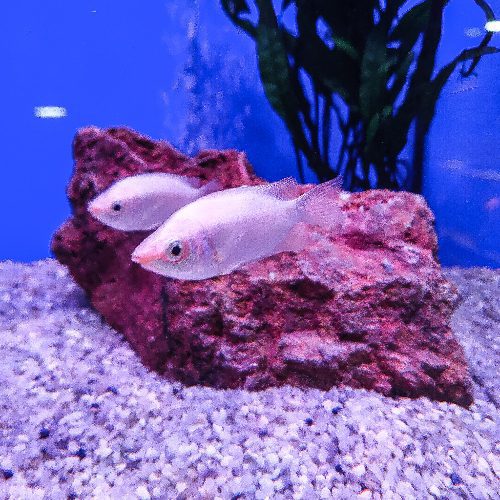
Kissing Gourami
Price range: £5.89 through £20.60
Care level: Easy
Max Size: 30cm
Temp: 22-28°C
PH: 6-8
Approximate purchase size: 3-4cm
Diet: Omnivore
Compatibility: Large Fish Community
Minimum Tank Size: 300L
Average Lifespan: Up to 20 years in captivity!
Description
Kissing Gourami – Helostoma temminckii
Overview
The Kissing Gourami – Helostoma temminckii is one of the larger species of gouramies. Though striking in appearance, they are certainly not for everyone as they grow to a substantial size and can be quite belligerent by nature and therefore not suitable for a smaller sized peaceful community.
Kissing Gourami Set Up
The aquarium should be very large on account of the kissing gourami’s sheer size. Filtration should be efficient and flow gentle. For this reason, regular water changes are necessary to maintain good water quality. A gap should be left between the surface of the water and the lid as this is a labyrinth species and should be able to breathe atmospheric air from time to time. Décor isn’t of particular importance as this is quite a confident species that prefers open swimming space and needs a lot of it because of the size it grows to. Plants are not generally recommended for Kissing Gourami as they have a tendency to damage them, though not necessarily eat them. Firmer species of plants like anubias are more likely to withstand the fish browsing them. The addition of wood is welcome as the fish like to graze on biofilm as part of their diet.
Kissing Gourami Behaviour
This fish gets its name from the way it appears to lock jaws or “kiss” other fish as a form of aggression. This movement of the mouth is specialised for grazing wood and sand and collecting plankton, microorganisms and small crustaceans. Kissing Gouramis are active, intelligent fish that spend much of their time grazing surfaces and interacting with tankmates. As they mature they become increasingly territorial and establish social hierarchies, often displaying the characteristic “kissing” behaviour as a test of strength rather than affection. In aquaria that are spacious enough, they don’t tend to cause too much bother. If several specimens are to be kept together, it is wise to add them all at the same time as newcomers to the group are seldom welcomed. This isn’t to say that some infighting won’t happen in an established group, so it the aquarium is smaller than 300L, we recommend keeping just one.
Tank Mates
Kissing Gourami are not predators and don’t really eat anything more than a few mm in size. As a result, there are actually quite a large number of species that they can be kept with, including most barbs, cichlids, eels, rainbowfish and larger catfish. Space is key to choosing tank mates and it’s best to avoid other gouramies or similarly shaped fish, as well as particularly small community fish and timid species.
Feeding Your Kissing Gourami
These gourami really do prefer small particle foods in their diet and are often found mouthing constantly. They have highly specialised gill plates and tiny teeth in their lips to enable them to sift out microorganisms and rasp biofilm and algae. They do not possess the ability to crush larger food items. But there’s plenty of other things that can be offered, such as good quality pellet foods, frozen foods such as mosquito larvae, brineshrimp, Mysis, krill etc. This is also one of the rare occasions when we feel that flake food is also appropriate as it is easily consumed and doesn’t require breaking down. They are partial to green plant matter from time to time, so offer veggie flakes, lettuce or cucumber from time to time.
If you have any queries about keeping this Kissing Gourami – Helostoma temminckii and whether they are suitable for you aquarium, please contact us and a member of our friendly store team will be more than happy to answer all of your questions
Why not check out our Instagram for the latest news on our products and livestock!
Additional information
| Multibuy | 2 For, 4 For, Each |
|---|
Related products
-

Red Tiger King Kong Parrot 4-5″
£109.99 Read more -
Assorted Discus Large
Price range: £74.99 through £120.00 Select options This product has multiple variants. The options may be chosen on the product page -
Red Devil Vampire Crab
Price range: £12.49 through £82.98 Select options This product has multiple variants. The options may be chosen on the product page -
Sale!
Siamese Algae Eater
Price range: £3.89 through £27.50 Select options This product has multiple variants. The options may be chosen on the product page