

Sub-Total: £0.00
Heads up! Livestock sells out quickly — please give us a quick call before visiting to check availability.
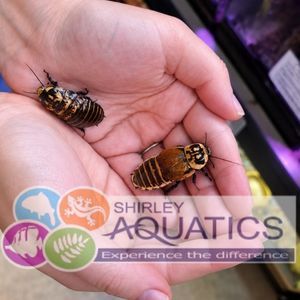
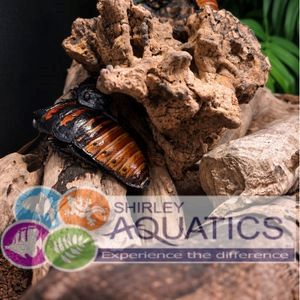
Headlight Cockroach (Lucihormetica verrucosa)
Price range: £3.99 through £26.51
- Scientific name: Lucihormetica verrucosa
- Common name: Headlight Cockroach / Warty Glowspot Cockroach
- Adult size: Approximately 4–5cm
- Temperature: Around 24–28°C
- Care level: Easy–moderate
- Diet: Omnivorous – vegetables, occasional fruit and suitable protein
- Temperament: Generally docile and secretive
- Activity: Primarily nocturnal
- Lifestyle: Burrowing – provide a good depth of substrate
- Housing: Warm, ventilated enclosure with leaf litter, wood and hides
- Special feature: Adult males develop two distinctive pale “headlight” markings
- Bioluminescent: No – the markings can fluoresce under UV but do not produce their own light
- Origin: South America
- Purchase Size: 4cm
Description
Headlight Cockroach
The Headlight Cockroach (Lucihormetica verrucosa) is an unusual South American cockroach best known for the pair of distinctive pale yellow to orange markings found on adult males. Sitting prominently on the pronotum, these markings resemble a tiny pair of headlights and give this fascinating species its common name.
Also known as the Warty Glowspot Cockroach, Lucihormetica verrucosa has a chunky, heavily textured appearance quite unlike the smoother-bodied Madagascan hissers. They’re relatively slow-moving, predominantly nocturnal and spend much of their time tucked beneath bark or partially buried in the substrate.
Perhaps most interestingly, those famous “headlights” have a bit of scientific history behind them. They were once described as bioluminescent organs, but subsequent research found no convincing evidence that L. verrucosa actually produces its own light. The spots do, however, show autofluorescence under UV light, and their colour can vary according to carotenoids in the animal’s diet.
Headlight Cockroach Care
Headlight Cockroaches appreciate a warm enclosure with a reasonably deep substrate and plenty of cover. Unlike hissers that spend a great deal of their time climbing around cork bark, Lucihormetica verrucosa has strong burrowing tendencies, so the substrate forms an important part of the enclosure rather than simply covering the bottom.
A mixture based around coco fibre, decayed leaf litter and suitable organic material works well. Keep part of the substrate slightly moist without allowing the enclosure to become permanently wet or stagnant.
Cork bark and pieces of rotten or decaying hardwood provide additional retreats at the surface and help create the shaded, naturalistic environment these cockroaches prefer.
Size and Appearance
Adult Headlight Cockroaches generally reach approximately 4–5cm, with females typically having a broader, heavier appearance.
Both sexes are attractive animals with dark brown to black bodies and a wonderfully rugged, almost prehistoric-looking texture.
The famous paired “headlights” are principally an adult male characteristic. Research into L. verrucosa has demonstrated strong sexual dimorphism, with males possessing the two prominent pronotal spots. Their colour can range from whitish-yellow through orange and even reddish tones depending partly upon dietary carotenoids.
So don’t be alarmed if your female appears to have left the factory without her headlights fitted.
Behaviour
Headlight Cockroaches are predominantly nocturnal and naturally secretive. During daylight hours they will frequently disappear beneath substrate, leaf litter or pieces of wood before emerging to explore and feed when conditions are quieter.
This burrowing behaviour means that an apparently empty enclosure may contain a perfectly healthy cockroach population quietly going about its business underground.
They can be kept communally when provided with sufficient room, food and retreats. As with most cockroaches, regular handling isn’t necessary, although individuals can be gently handled when required.
Feeding
Lucihormetica verrucosa is an omnivorous scavenger and should be provided with a varied diet.
Offer vegetables such as carrot, squash and leafy greens alongside occasional fruit and a suitable dry protein source. Decaying leaves and wood can also be incorporated into a naturalistic enclosure.
Carrot is particularly interesting with this species. Scientific studies have demonstrated that the colour of the male’s pronotal spots is influenced by dietary carotenoids, with greater carotenoid intake producing more orange or reddish pigmentation.
Remove uneaten fresh food before it deteriorates and ensure that a safe source of moisture or drinking water is always available.
Breeding
Headlight Cockroaches can reproduce readily once established under suitable warm conditions.
Like a number of other members of the Blaberidae family, females retain their developing egg case internally and subsequently produce live nymphs rather than leaving an exposed ootheca around the enclosure. Research describing reproduction in L. verrucosa records the species as viviparous.
Young cockroaches spend considerable time within the substrate, so established colonies benefit from plenty of organic material and hiding places.
Do Headlight Cockroaches Really Glow?
Sadly, you cannot switch the lights off and expect a pair of tiny headlights to illuminate the terrarium.
Early reports suggested that members of Lucihormetica were bioluminescent, but detailed examination of L. verrucosa found no evidence that the yellow spots are genuine light-producing organs. Researchers instead found carotenoid-containing tissue beneath translucent cuticle.
The markings can autofluoresce when exposed to ultraviolet light, which probably helped fuel the original misconception. That’s fluorescence in response to an external light source rather than the cockroach generating light itself.
Frankly, a cockroach with two fake headlights is arguably even more interesting.
An Unusual Display Invertebrate
The combination of their unusual appearance, burrowing behaviour and distinctive male markings makes the Headlight Cockroach an excellent addition to an invertebrate collection.
They’re sufficiently different from Madagascan hissers to make keeping both worthwhile, and a naturalistic enclosure with deep substrate, leaf litter and pieces of cork provides plenty of opportunity to observe their natural behaviour.
For keepers looking beyond the more commonly available pet cockroaches, Headlight Cockroaches are a wonderfully weird little species.
If you have any questions about keeping the Headlight Cockroach (Lucihormetica verrucosa), please contact us and a member of our friendly reptile team will be able to advise you.
Why not check out our photos of some of the best livestock we’ve had in store over the years!
Additional information
| Multibuy | 2 For, 4 For, 8 For, Each |
|---|
Related products
-

Heat Mat 17 x 11″
£20.99 Add to cart -
Frozen Rats Reptile Food – Pups to Extra Large
Price range: £1.20 through £68.99 Select options This product has multiple variants. The options may be chosen on the product page -
Habistat Heat Mat 6 x 11″
£17.29 Add to cart -
Heat Mat 11 x 11″
£18.99 Add to cart