Sub-Total: £25.12
-
×

Subtotal: £25.12



Price range: £5.09 through £9.47
Scientific Name: Fundulopanchax gardneri
Common Name: Gardneri Killifish / Blue Lyretail
Adult Size: Approximately 6.5cm
Minimum Aquarium: 60cm length recommended
Temperature: 22–25°C
pH: 6.0–7.2
Hardness: 5–8 dH
Temperament: Generally peaceful; males can be territorial
Diet: Carnivorous – quality dry foods supplemented with live and frozen foods
Swimming Level: All levels, particularly middle and upper areas
Difficulty: Easy–Intermediate
Suitable For: Planted aquariums, carefully selected communities and dedicated killifish setups
Approximate Purchase Size: 3-4cm
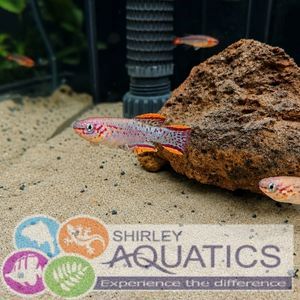
The Gardneri Killifish (Fundulopanchax gardneri) is a spectacular West African killifish that combines intense colour with plenty of personality. Mature males are particularly impressive, developing a colourful pattern of red spots across the body with strongly marked dorsal, anal and tail fins. Females are considerably more understated, but still attractive fish in their own right.
Gardneri Killifish are a great choice for aquarists who fancy trying something a little different from the usual community fish. They are relatively straightforward to keep, readily take a variety of foods and, once settled, tend to be confident and inquisitive.
Unlike some of the better-known annual killifish, Fundulopanchax gardneri is not an annual species. In the wild it inhabits permanent waters including streams, brooks and swampy habitats rather than relying upon a life cycle tied entirely to temporary seasonal pools.
We recommend an aquarium of at least 60cm in length for Gardneri Killifish, particularly when keeping a pair or small group.
A planted aquarium suits them extremely well. Dense areas of vegetation around the sides and back of the aquarium provide security and allow fish to get away from one another when necessary, while leaving some open swimming space towards the front.
Floating plants are particularly useful. They help diffuse bright aquarium lighting and provide the slightly shaded conditions in which these fish often appear more comfortable and confident.
Wood, smooth rocks, leaf litter and other natural decoration can also be used to create plenty of structure.
Filtration doesn’t need to produce enormous amounts of flow. Gardneri Killifish naturally occur in a variety of habitats including brooks, streams and swampy waters, and we would favour good filtration with moderate rather than excessively powerful water movement.
Use a tight-fitting lid. Like most killifish, Gardneri are excellent jumpers and are capable of finding gaps around lids, cables and filter pipework that you wouldn’t necessarily expect a fish to fit through.
Gardneri Killifish don’t need an especially warm aquarium. A temperature of approximately 22–25°C is ideal, making them suitable for many conventional tropical setups without needing to push the temperature towards the upper end of the tropical range.
They naturally favour relatively soft water, pH of 6.0–7.2 and hardness of 5–8 dH.
As always, we would rather see fish maintained in clean, stable water than have an aquarist constantly altering the chemistry in pursuit of a precise number.
Gardneri Killifish are fascinating little characters and are generally considerably more noticeable than their size might suggest.
Once comfortable in their surroundings they can be quite bold, spending plenty of time exploring the aquarium and quickly learning when food is on its way.
They are not shoaling fish, however, and their social behaviour needs to be considered when deciding how many to keep.
Males can be territorial towards one another, displaying, chasing and occasionally squabbling. This doesn’t necessarily mean that only one male can ever be kept in an aquarium, but multiple males need sufficient space and plenty of broken lines of sight.
Females can also be subjected to persistent attention from males, so dense planting and other areas of cover are important.
They’re therefore peaceful in the broad sense of the word, but I wouldn’t describe them as completely placid. They have a little more attitude than their diminutive size might suggest – which is actually part of their appeal.
Gardneri Killifish can be kept alongside other fish, but we recommend choosing their companions carefully.
Small to medium-sized peaceful species that enjoy similar temperatures and water conditions are generally the best choices. Smaller peaceful barbs, rasboras, suitable tetras and Corydoras can all potentially work well.
We would avoid particularly aggressive cichlids and very boisterous fish that may continually outcompete them at feeding time.
Tiny fish and very small fry should also be treated with caution. Gardneri are opportunistic predators and something small enough to fit into their mouth may well be regarded as food.
If breeding them is the priority, a dedicated aquarium is considerably easier than attempting to raise fry in a community setup.
Gardneri Killifish are carnivorous by nature and particularly appreciate small meaty foods.
Good-quality flakes and small pellets can form part of their aquarium diet, but we strongly recommend supplementing these with live and frozen foods.
Brineshrimp, daphnia, mosquito larvae, bloodworm and other suitably sized live or frozen foods are excellent choices.
Live foods are especially worthwhile with killifish. Not only are they highly nutritious, but the movement encourages the fish to hunt and produces a natural feeding response that isn’t quite replicated by dry food.
A varied, protein-rich diet is also particularly useful when conditioning adults for breeding.
Gardneri Killifish offer something genuinely different without requiring an enormously complicated aquarium.
They’re small enough for modest-sized setups, the males develop exceptional colour, and their confident, inquisitive behaviour makes them much more than simply an ornamental fish.
They’re also an excellent stepping stone into the wider world of killifish. You get much of the colour and fascinating breeding behaviour for which the group is famous without having to begin with one of the more specialised annual species.
For a planted aquarium maintained at moderate tropical temperatures, they’re a fish we think deserves to be considered far more often.
Just remember to close that lid.
We wouldn’t consider them aggressive community fish, but neither are they completely without territorial behaviour.
Males may display and chase one another, particularly where space or access to females is limited. A well-planted aquarium containing plenty of visual barriers makes a considerable difference.
Yes. Gardneri can make good community inhabitants when kept with appropriately sized, peaceful fish that enjoy similar conditions.
Avoid very aggressive or boisterous tank mates, and remember that extremely small fish or fry may be viewed as prey.
Yes, providing the aquarium is large enough and contains plenty of plants and visual barriers.
Male-on-male displaying and chasing is normal. In a small, sparsely decorated aquarium, however, a dominant male may make life difficult for a subordinate fish.
No. Fundulopanchax gardneri are not shoaling fish.
They can be kept as pairs or in appropriately structured small groups. When keeping a group, consideration should be given to the number of males and the amount of cover available.
No. Fundulopanchax gardneri is not a seasonal or annual killifish.
This is an important distinction because their breeding cycle does not depend upon the prolonged dry period associated with annual killifish from temporary pools.
Not particularly.
Providing you can offer good water quality, appropriate tank mates, a varied diet and a suitably covered aquarium, we consider Gardneri one of the more approachable killifish for somebody wanting to explore the group.
Jumping is a natural behaviour amongst killifish and isn’t necessarily an indication that anything is wrong with the aquarium.
Unfortunately, they’re extremely good at it.
Always use a secure lid and check carefully for openings around filter pipes, cables and feeding holes.
Gardneri readily accept a variety of aquarium foods, although we recommend a diet with a strong emphasis on appropriately sized meaty foods.
Live and frozen brineshrimp, daphnia, mosquito larvae and bloodworm are excellent choices alongside good-quality flakes or small pellets.
If you have any questions about keeping the Gardneri Killifish, please contact us and a member of our team will be able to advise you.
Why not check out our photos of some of the best livestock we’ve had in store over the years!
| Multibuy | 2 For, Each |
|---|