


Sub-Total: £0.00
Heads up! Livestock sells out quickly — please give us a quick call before visiting to check availability.
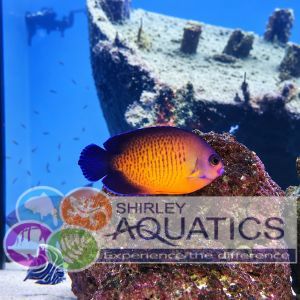
Coral Beauty Medium
Original price was: £37.99.£34.99Current price is: £34.99.
Scientific name: Centropyge bispinosa
Common name: Coral Beauty Angelfish
Family: Pomacanthidae
Maximum size: Approx. 10–12cm
Purchase size: Approx. 4–5cm
Minimum aquarium: Approx. 200–250 litres
Temperature: 23–27°C
pH: 8.1–8.4
Specific gravity: 1.023–1.026
Temperament: Semi-aggressive / territorial
Diet: Omnivore
Reef safe: With caution
Care level: Intermediate
Origin: Indo-Pacific
Best kept: Singly in most home aquariums
Available on backorder
Description
Coral Beauty Angelfish
The Coral Beauty Angelfish (Centropyge bispinosa) is one of the most popular dwarf marine angelfish, combining striking colour with a relatively manageable adult size. Deep blue and purple around the head and fins contrasts beautifully with orange to reddish colouring across the body, with considerable natural variation between individuals.
Growing to around 10–12cm, the Coral Beauty is an active fish that spends much of its day weaving through rockwork and grazing from its surface. Once settled it can become a confident and highly visible member of the aquarium, although plenty of caves and sheltered areas should always be provided.
Hardier than many marine angelfish, it can make an excellent choice for an aquarist with some marine experience and a mature, well-established aquarium.
Coral Beauty Angelfish Set Up
The Coral Beauty Angelfish should be housed in a mature marine aquarium with plenty of established rockwork.
Rockwork should provide caves and crevices for shelter while leaving sufficient open space for swimming. Mature rock also provides natural grazing opportunities, which form an important part of this species’ daily behaviour.
We recommend an aquarium of around 200–250 litres or larger for a single adult, with additional space particularly valuable when keeping the Coral Beauty alongside other active or territorial species.
Behaviour
Coral Beauties are semi-aggressive and can become territorial once established.
They may initially be shy after introduction, spending considerable time close to the rockwork. Once comfortable, however, they generally become active and inquisitive fish that regularly patrol the aquarium.
They can be particularly territorial towards other dwarf angelfish and similarly shaped species.
For most aquariums, we recommend keeping one Coral Beauty per aquarium rather than attempting to maintain several dwarf angels together.
Coral Beauty Angelfish Tank Mates
A Coral Beauty can live successfully in a mixed marine community with appropriately chosen tank mates.
Suitable companions include many peaceful to moderately assertive marine fish that are large and confident enough not to be intimidated.
Very timid species may struggle with a particularly territorial individual, while other Centropyge dwarf angelfish should generally be avoided unless the aquarium is exceptionally large and the keeper has experience managing their aggression.
Introducing the Coral Beauty after more peaceful inhabitants have established themselves can also help reduce territorial problems.
Feeding
The Coral Beauty Angelfish is an omnivorous grazer and should receive a varied diet containing both algae-based and meaty foods.
Suitable foods include:
- Marine algae and seaweed
- Spirulina-based foods
- Specialist marine angelfish foods
- Mysis shrimp
- Enriched brineshrimp
- Quality marine pellets and flakes
- Suitable frozen marine preparations
Established live rock provides valuable additional grazing opportunities throughout the day.
Offering a varied diet rather than relying on a single food helps maintain good body condition and strong colouration.
Is the Coral Beauty Angelfish Reef Safe?
Reef safe with caution.
Many Coral Beauties are successfully kept in reef aquariums, but no individual can be guaranteed completely coral safe.
Like other dwarf angelfish, some specimens may nip at fleshy LPS corals, soft coral polyps, zoanthids, clam mantles and other sessile invertebrates.
Others may live in a reef aquarium for years without causing noticeable damage.
A well-fed fish with plenty of mature rockwork to graze may be less inclined to investigate corals, but the risk can never be completely eliminated.
Coral Beauty Angelfish Water Parameters
Temperature: 23–27°C
pH: 8.1–8.4
Specific gravity: 1.023–1.026
Alkalinity: Approximately 8–12 dKH
Stable water conditions are particularly important. Avoid introducing a Coral Beauty to a newly established aquarium where water chemistry and biological filtration are still developing.
Coral Beauty Angelfish Care Level
Intermediate
The Coral Beauty is generally regarded as one of the hardier dwarf angelfish, but we’d still place it at intermediate level rather than recommending it as someone’s first marine fish.
Its diet, territorial behaviour, need for established rockwork and uncertain reef compatibility all require a little more consideration than a straightforward community species.
Given a mature aquarium, varied diet and sensible tank mates, however, the Coral Beauty can become a hardy and spectacular long-term aquarium resident.
Why Choose a Coral Beauty Angelfish?
It’s quite easy to see why the Coral Beauty has remained one of the hobby’s most popular dwarf angels.
You get much of the colour, personality and presence associated with larger marine angelfish in a species that reaches only around 10–12cm.
They’re constantly exploring the rockwork rather than simply hovering in one part of the aquarium, and the combination of electric blue, purple and fiery orange makes even fairly modest individuals difficult to overlook.
For a mature marine aquarium where a little personality is welcome, the Coral Beauty is an excellent choice.
If you have any questions about keeping these fish and whether they’re suitable for you, please contact us and a member of our friendly store team will be more than happy to answer all of your questions
Why not check out our other photos of some of the best livestock to have graced our tanks!
Related products
-

Coral Essentials Coral Power – Gro
Price range: £16.95 through £29.95 Select options This product has multiple variants. The options may be chosen on the product page -
Triton Trace Base – Calcium
£21.49 Add to cart -
Triton Trace Base – Cobalt
£19.99 Add to cart -
Triton Trace Base – Nickel
£19.99 Add to cart


