Sub-Total: £25.12
-
×

Subtotal: £25.12



Price range: £8.49 through £56.41
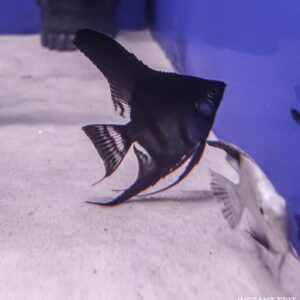
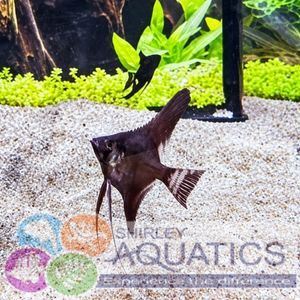
The Black Angelfish is a striking colour form of Pterophyllum scalare, combining the unmistakable tall, laterally compressed shape of an angelfish with rich, dark colouration. Against green plants, pale substrate or lighter décor, a well-coloured Black Angelfish can become one of the most eye-catching fish in the aquarium.
Like other freshwater angelfish, they are members of the cichlid family and have considerably more personality than their elegant appearance might suggest. Juveniles are usually sociable, inquisitive fish, while mature individuals can become more assertive and territorial, particularly when a pair forms.
Although they’re often sold quite small, angelfish shouldn’t be thought of as small aquarium fish. Their long dorsal and anal fins give adults considerable height, making aquarium dimensions and particularly tank depth important when choosing a permanent home.
Black Angelfish are best suited to a spacious, mature tropical aquarium with plenty of vertical swimming room.
A combination of taller plants, wood and open swimming areas suits them particularly well. Upright décor and planting also provide useful visual barriers when several angelfish are kept together.
Their natural body shape is designed more for manoeuvring amongst submerged vegetation and branches than battling powerful currents, so excessively turbulent flow isn’t necessary.
Because adults are considerably taller than their body length alone suggests, a deeper aquarium is preferable to a shallow one.
Angelfish are cichlids, and that’s worth remembering when choosing them for a community aquarium.
Most are relatively peaceful outside breeding, but individuals can establish territories and a group will usually develop a social hierarchy. Once two fish pair up, they may defend an area of the aquarium quite vigorously against other fish.
This doesn’t make Black Angelfish aggressive fish as such, but it does mean they’re more complicated than simply labelling them “peaceful”.
Keeping several together requires enough room for individuals to establish space and get away from one another when necessary.
The best companions are peaceful fish that are large enough not to be regarded as food but aren’t inclined to harass the angelfish.
Corydoras and many peaceful catfish can work well, along with suitably sized tetras, rasboras and other calm community species.
There are two particular things to watch for.
Very small fish can potentially be eaten by mature angelfish, while notorious fin-nippers can find those long angelfish fins extremely tempting.
This is also why a combination that works perfectly when all the fish are juveniles may need reassessing as the angelfish mature.
Young angelfish can be kept together, but their relationships often change as they mature.
A group will develop a hierarchy and eventually pairs may form. At that point, previously sociable fish can become much more territorial, particularly around a chosen spawning site.
A larger aquarium with plants, wood and broken lines of sight gives subordinate fish somewhere to retreat and can make managing a group considerably easier.
It’s worth watching the group rather than assuming that because the fish got along when purchased, they’ll always behave in exactly the same way.
Black Angelfish are omnivorous and generally enthusiastic feeders.
A quality tropical flake, granule or small pellet makes a good staple, supplemented with suitable frozen or live foods such as brine shrimp, mysis and bloodworm.
Offering a varied diet rather than relying entirely on one food helps provide balanced nutrition and gives the fish greater feeding enrichment.
Be aware that angelfish can become very confident at feeding time. In a mixed aquarium, make sure quieter bottom-dwelling or slower fish are also getting their share.
The appeal of this variety is really its simplicity.
Rather than elaborate stripes or marbled patterns, the deep dark body colour emphasises the classic angelfish silhouette. The contrast can be particularly effective in planted aquariums, where the fish stands out beautifully against fresh green foliage.
Colour intensity can vary between individual fish and can also appear different according to lighting, surroundings and the fish’s condition.
If you’re choosing in store, we’d always recommend looking at the individual fish rather than expecting every Black Angelfish to be an identical shade.
If you have any questions about this fish and whether it’s suitable for your aquarium, please contact us and a member of our friendly tropical team will be more than happy to answer all of your questions.
Why not check out our Instagram for the latest news on our products and livestock!
| Multibuy | 2 For, 4 For, 8 For, Each |
|---|