

Sub-Total: £0.00
Heads up! Livestock sells out quickly — please give us a quick call before visiting to check availability.
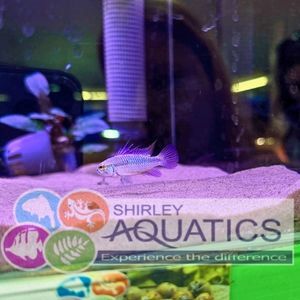
Apistogramma trifasciata
Price range: £9.99 through £34.93
Adult Size: 5–6cm
Minimum Aquarium: 60 litres
Temperature: 20–26°C
Ideal Temperature: 22–25°C
pH: 5.5–7.5
Temperament: Peaceful / Territorial when breeding
Diet: Omnivore
Swimming Area: Bottom
Difficulty: Intermediate
Approximate Purchase Size: 2.5-3cm
Description
Apistogramma trifasciata
Apistogramma trifasciata, commonly known as the Three-Striped Dwarf Cichlid, is a beautiful South American dwarf cichlid known for its striking markings, impressive finnage and fascinating behaviour. Mature males can develop elongated fins with beautiful blue colouration, while females remain smaller and develop an intense yellow colour when breeding.
Despite their small size, these fish have all of the personality and complex social behaviour that make cichlids so interesting to keep. They are an excellent choice for aquarists wanting a characterful centrepiece fish for a smaller South American aquarium.
Apistogramma trifasciata Set Up
A well-structured aquarium is much more important to Apistogramma than simply providing lots of open space. We recommend using fine sand with plenty of bogwood, plants, caves and leaf litter to create sheltered areas and natural territorial boundaries.
Apistogramma spend most of their time relatively close to the substrate, investigating wood, leaves and plants for food. Fine sand allows them to forage naturally by taking small mouthfuls of substrate and sifting through it in search of edible material.
Water movement should be relatively gentle and good water quality is essential. They particularly appreciate a mature aquarium with plenty of cover rather than a newly established, sparsely decorated tank.
Behaviour
Apistogramma trifasciata are fascinating little fish with considerably more personality than their size might suggest. Males spend much of their time patrolling their territory and displaying their fins to females, rivals and occasionally their own reflection.
Rather than constantly fighting, much of their communication consists of body posture, colour changes and impressive fin displays. Providing plenty of plants, wood and other visual barriers allows individuals to establish territories without constantly seeing one another.
Females undergo one of the most dramatic behavioural changes when breeding. A female guarding eggs or fry develops an intense yellow colouration and becomes an extremely attentive parent. She will defend the immediate area around her brood and guide newly free-swimming fry around the aquarium in search of food.
Watching a tiny female Apistogramma confidently escort a cloud of fry around the aquarium is one of the reasons we find this group of dwarf cichlids so rewarding to keep.
Tank Mates
Apistogramma trifasciata can be kept alongside small, peaceful community fish that aren’t excessively boisterous at feeding time. Small tetras and pencilfish can make particularly good companions because they occupy the middle and upper areas of the aquarium while the Apistogramma spend most of their time closer to the bottom.
We would avoid aggressive cichlids, very active barbs and other species that continually compete with them for territory around the substrate.
Care should also be taken with other bottom-dwelling fish, particularly in smaller aquariums. A breeding female can become surprisingly determined when protecting her eggs or fry and may continually chase fish that enter her territory.
Feeding
Apistogramma trifasciata are omnivorous with a strong preference for small meaty foods. A quality small cichlid pellet can form part of their diet, supplemented regularly with frozen or live foods such as brineshrimp, bloodworm, daphnia and mosquito larvae.
Live and frozen foods are particularly useful when conditioning Apistogramma for breeding and often encourage stronger natural feeding responses than dried foods alone.
Why We Recommend Apistogramma trifasciata
Apistogramma trifasciata is a fantastic choice for aquarists who want to experience genuine cichlid behaviour without requiring an enormous aquarium. Their territorial displays, courtship behaviour and excellent parental care make them endlessly interesting to watch.
We particularly like them in natural-looking planted aquariums with sand, wood and leaf litter, where their behaviour really comes into its own. Mature males are impressive fish, but watching a brightly coloured female caring for her fry can be every bit as interesting.
Frequently Asked Questions
How big do Apistogramma trifasciata grow?
They remain relatively small. Males are the larger sex and generally reach around 5–6cm, while females remain noticeably smaller.
Are Apistogramma trifasciata aggressive?
They are territorial rather than generally aggressive. Males may display towards rivals and females become considerably more defensive when guarding eggs or fry. Providing caves and plenty of visual barriers helps individuals establish their own territories.
Should Apistogramma trifasciata be kept as a pair or group?
They can be kept as a pair, although in a sufficiently large and well-structured aquarium it is possible to keep a male with multiple females. Each female must have enough space to establish her own territory and access to a suitable cave.
For most smaller home aquariums, we would recommend starting with a compatible pair rather than trying to maintain a larger group.
What size aquarium do Apistogramma trifasciata need?
We recommend an aquarium of at least 60 litres for a pair. More important than volume alone is providing sufficient floor space, caves and visual barriers so that each fish can retreat when necessary.
Larger aquariums are recommended if keeping multiple females or additional bottom-dwelling species.
Do Apistogramma trifasciata need caves?
Yes. Caves are particularly important if you intend to breed them. Females naturally choose small, sheltered areas in which to lay their eggs and will defend the surrounding territory once spawning has taken place.
Coconut caves, small ceramic caves and suitably arranged pieces of bogwood can all work well.
Are Apistogramma trifasciata suitable for a community aquarium?
Yes, provided their tank mates are peaceful and the aquarium is appropriately structured. Small tetras and pencilfish are particularly good choices. Bear in mind that even a normally peaceful female will defend her territory vigorously when caring for fry.
Are Apistogramma trifasciata difficult to keep?
We would consider them an intermediate species rather than an ideal first fish. They aren’t especially difficult when their requirements are met, but they benefit from stable water conditions, good water quality and a carefully designed aquarium.
If you have any questions about keeping the Apistogramma trifasciata, please contact us and a member of our team will be able to advise you.
Why not check out our photos of some of the best livestock we’ve had in store over the years!
Additional information
| Multibuy | 2 For, 4 For, Each |
|---|
Related products
-

24K Gold Kelberi Peacock Bass
£129.99 Read more -
Red Tiger King Kong Parrot 4-5″
£109.99 Read more -
Sale!
Common Pleco
Price range: £6.99 through £24.44 Select options This product has multiple variants. The options may be chosen on the product page -
Albino Gibbiceps Pleco
£9.99 Read more