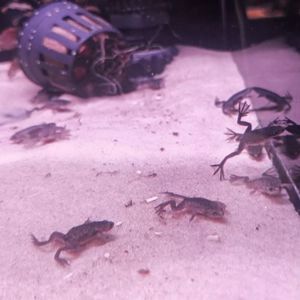
The African Dwarf frog is a popular choice of amphibian for aquarists who want to have something more unusual in their aquarium. These small frogs are a perfectly peaceful species as long as they are not kept with anything smaller than themselves that also doesn’t move terribly fast, like shrimp.
African Dwarf Frog set up
While they are fully aquatic and will never leave the water by choice, they do need to be able to breathe atmospheric air. For that reason, it is important that the depth of the water is taken into consideration when purchasing these frogs. They must be able to access the surface, but if the distance from the base of the tank is quite considerable, they may run out of energy and never make it. Equally, strong flow can prevent the frogs from being able to get around efficiently. Sand substrate is highly recommended for frogs as they may accidentally ingest gravel. The addition of bog wood and plants is always welcome and gives the frogs hiding spots and natural enrichment. Water quality is crucial for frogs as they are very sensitive to pollutants.
Behaviour
Peaceful by nature, these frogs are social with their own kind. They spend much of their time mooching around the tank for food or relaxing together. Though they can be somewhat shy when first introduced to the aquarium, they will soon settle in and be seen walking around the aquarium and dashing to the surface for air. Many keepers find them to be highly entertaining because of their unusual behaviours and swimming style.
These frogs rely very heavily on their sense of smell for locating food, so they can be quite slow to find it.
It’s best to keep them in small groups of 3 or more to allow their natural behaviours to emerge.
Tank Mates
These peaceful amphibians can be kept with most peaceful community fish, but they can be somewhat slow to respond to food. It’s important to ensure that they get their fair share of food, so it’s best to avoid particularly boisterous species. Particularly small species and shrimp should also be avoided. These frogs are by no means accomplished hunters, but they will still attempt to eat anything that fits in their mouths.
Feeding
Food can be offered in the form of amphibian pellets, frozen bloodworm, brine shrimp and daphnia.
Can African Dwarf Frogs be kept with tropical fish?
Yes, they will cohabit with tropical fish just fine. It is important to note that frogs will try to eat anything that they can fit in their mouths, so the fish need to be of a reasonable size to avoid predation. Equally, large aggressive species like Cichlids should be avoided as they may harass the frogs.
Do these frogs need to be able to come up for air?
Yes. In the absence of gills, aquatic animals must be able to reach the surface in order to breathe. For this reason we would not recommend these frogs for particularly deep aquariums as they may run out of energy before reaching the surface and will eventually drown as a result.
Can I mix these African Dwarf Frogs with the gold ones?
Absolutely. The gold variety of Hymenochirus is the same as the brown variety and the frogs don’t distinguish between their physical appearance.
Does my tank need a lid for these frogs?
Yes. Whilst they are fully aquatic and don’t like to leave the water, they can be accomplished escape artists if the water quality isn’t to their liking. It’s best to keep them in a lidded aquarium to prevent any frogs from going on big adventures.
If you have any questions about keeping these frogs and whether they’re suitable for your aquarium, please contact us and a member of our friendly store team will be more than happy to answer all of your questions.
Why not check out our Instagram for the latest news on our products and livestock!